
Complete Guide · Air Taxi
Executive Air Taxi Guide: how to charter an aircraft safely
Everything you need to know about private jet charter in Brazil: how it works, how much it costs, which aircraft to use and how to check that the company is authorized by ANAC.
By Régis Hahns, CEO of Embarque Oficial · LinkedIn
- 2011flying since
- 45 minread
- 20sources cited
What is an executive air taxi?
An executive air taxi is the charter of an entire aircraft, with crew, to fly at the time and on the route the client chooses. In Brazil, air taxi is a non-scheduled public air transport service, operated only by companies certified by ANAC (Agência Nacional de Aviação Civil), Brazil's civil aviation authority, under RBAC 135, with the aircraft linked in the RAB (Brazilian Aeronautical Registry) to an operator authorized to provide 135 service and covered by mandatory RETA liability insurance. The price is charged per aircraft, not per seat, and depends on the hourly rate, positioning, overnights and fees. Before flying, check the company and the registration in ANAC's public systems.
In this guide
- What is an executive air taxi and how does private jet charter in Brazil work?
- Air taxi (RBAC 135), private aviation (RBAC 91) and scheduled airlines: what is the difference?
- How does ANAC certify an air taxi company in Brazil?
- How do you check whether an executive air taxi operator and its aircraft are legal?
- How to book an executive air taxi: step by step
- How much does an executive air taxi cost and how is the price calculated?
- What are empty legs and when are they worth it?
- Which aircraft should you choose for each executive air taxi mission?
- When is a helicopter the best air taxi choice?
- What are the main executive airports and heliports in Brazil, and their restrictions?
- How do international executive air taxi flights and flights to South America work?
- Safety, RETA insurance and responsibilities: what should passengers know?
- Executive air taxi for companies: roadshows, corporate programs and the Jet Card
- Glossary
- Frequently asked questions
What is an executive air taxi and how does private jet charter in Brazil work?
An executive air taxi is a non-scheduled public air transport service in which the client hires the entire aircraft, with crew, to fly on the day, at the time and on the route of their choice. In Brazil, ANAC (Agência Nacional de Aviação Civil), the country's civil aviation authority, classifies air taxi as a type of non-scheduled air transport service, and the companies that provide it operate under RBAC 135 (Regulamento Brasileiro da Aviação Civil, the Brazilian Civil Aviation Regulation). In the market, the terms charter, charter flight, private jet charter, chartered jet and aircraft hire with crew are often used as synonyms. Legally, however, only a company authorized and certified by ANAC may sell passenger air transport for remuneration.
How charter works in practice
In executive charter, you pay for the aircraft, not for a seat. The client sets the origin, the destination, the departure time and the number of passengers, up to the aircraft's seat limit. The air taxi operator is responsible for the crew, maintenance, flight planning, mandatory insurance and compliance with the rules of ANAC and DECEA (Departamento de Controle do Espaço Aéreo), Brazil's airspace control department. Passengers board at general aviation terminals, VIP lounges or FBOs, usually with just a few minutes of formalities, and can fly to airstrips that no scheduled airline serves.
A typical charter flight follows five stages: the quote request, the proposal with aircraft and price, the signing of the contract, payment and boarding. Throughout this guide, each stage is explained in detail, together with the precautions that prevent pricing surprises and safety risks.
Why air taxi is growing in Brazil
According to ANAC data compiled by ABAG (Associação Brasileira de Aviação Geral), the Brazilian General Aviation Association, and published in July 2026, Brazil's business aviation fleet totaled 11,362 operational aircraft in May 2026, up from 10,893 in May 2025. Business jets rose from 1,060 to 1,193 over the same period, an increase of 12.5%. The fleet dedicated to air taxi reached 739 aircraft in May 2026, growth of 5.6% over the 700 registered a year earlier. With these figures, ABAG ranks Brazil as the second-largest business aviation market in the world, behind only the United States.
The core argument for an executive air taxi is reach. According to ABAG, scheduled airlines serve just over 147 locations in Brazil, while business aviation can reach more than 5,500 municipalities. In a continent-sized country, with farms, industrial hubs, mining areas and beach destinations far from major airports, this means trading a full day of connections and roads for a few hours of direct flight.
Who uses executive air taxi the most
- Companies that need to take executives and technical teams to several cities on the same day, for factory visits, audits and roadshows.
- Agribusiness, with frequent trips between state capitals and farms in the Center-West, the Matopiba region and the North.
- Families and leisure groups flying to destinations such as Trancoso, Angra dos Reis, Jericoacoara, Punta del Este and Fernando de Noronha.
- Events and emergencies, such as weddings, Grand Prix races, sports finals, organ transport and air ambulance transfers, which have their own rules.
Embarque Oficial's role in private jet charter in Brazil
Embarque Oficial organizes executive air taxi flights with air taxi operators certified by ANAC. This means the company sources the aircraft that suits the mission, compares proposals, checks the operator's and the aircraft's documentation and accompanies the client through to disembarkation. The flight operation itself is always carried out by a company holding an Air Operator Certificate, which signs the contract of carriage with the passenger. For frequent flyers, Embarque Oficial also offers the Jet Card, the Clube Infinity and aircraft management, acquisition, sales and financing services.
Air taxi (RBAC 135), private aviation (RBAC 91) and scheduled airlines: what is the difference?
The difference between air taxi, private aviation and scheduled aviation lies in who may charge for transport and which ANAC regulation applies. The Brazilian Civil Aviation Regulation (RBAC) sets different requirements for each type of operation, and that difference is precisely what separates a legal charter flight from an illegal one.
RBAC 135: air taxi and on-demand operations
RBAC 135 sets out the operating requirements for commuter and on-demand operations, which are the foundation of air taxi in Brazil. An RBAC 135 company has gone through an ANAC certification process and holds an Air Operator Certificate (COA, Certificado de Operador Aéreo), Operations Specifications (Especificações Operativas) stating which aircraft and types of operation it may conduct, approved manuals, a pilot training program, a safety management system and mandatory insurance. According to the official certification service published on gov.br, the scope of RBAC 135 covers aircraft with up to 19 passenger seats, and aircraft used for air taxi must be linked, in the RAB (Registro Aeronáutico Brasileiro, the Brazilian Aeronautical Registry), to an operator authorized to provide 135 service.
RBAC 91: private aviation and own use
RBAC 91 contains the general operating rules for civil aircraft and governs private aviation, that is, owners who fly their own aircraft for personal use or for their own company, without selling transport to third parties. A private aircraft may be excellent and well maintained, but it cannot be hired out with crew to carry passengers for payment. When that happens, it constitutes clandestine air transport, known in Brazil as TACA, which violates ANAC regulations and exposes passengers to safety risks and to a lack of insurance coverage.
Scheduled aviation: airlines
Scheduled aviation is made up of airlines that sell individual tickets on flights with published timetables, such as Azul, Gol and Latam. Major airlines operate under RBAC 121, with larger aircraft and their own rules for networks, tickets, baggage and passenger rights. The passenger buys a seat, not the aircraft, and adapts to the airline's network and airports.
Quick comparison
| Criterion | Air taxi (RBAC 135) | Private aviation (RBAC 91) | Scheduled aviation (RBAC 121) |
|---|---|---|---|
| Who may charge | Company certified by ANAC | No one: own use only | Authorized airline |
| What you buy | The entire aircraft | Nothing is sold | A seat |
| Schedule and route | Set by the client | Set by the owner | Published network |
| Company certificate | COA and Operations Specifications | Not applicable | COA and Operations Specifications |
| RETA insurance | Mandatory, with passenger coverage | Mandatory for the aircraft operator | Mandatory |
What about shared ownership and the Jet Card?
Prepaid hour programs, such as the Jet Card, and shared ownership models do not change the underlying rule: if transport is being sold, the flight must be operated by an authorized company. Before joining any program, check which RBAC 135 operator will fly it. Embarque Oficial structures the Jet Card and its flight programs exclusively with certified operators. For the full picture of the sector, including fleet and trends, see the Business Aviation Guide.
- A legal air taxi is always operated by a company holding an ANAC COA
- A private aircraft (RBAC 91) cannot be hired out with a pilot
- In a charter you pay for the aircraft, not per seat
- Jet Cards and flight programs also depend on an RBAC 135 operator
How does ANAC certify an air taxi company in Brazil?
ANAC certifies an air taxi company through a formal process, conducted in the VOE 135 system, which ends with the issuance of the Air Operator Certificate (COA) and the Operations Specifications (EO) and the publication of an ordinance in the Diário Oficial da União (DOU), Brazil's federal official gazette. According to the official service charter published on gov.br, the process is divided into five phases and has an estimated total timeframe of up to 225 calendar days.

The five phases of RBAC 135 certification
| Phase | What happens | Average timeframe |
|---|---|---|
| I | Pre-application orientation meeting with ANAC | 15 days |
| II | Filing of the Formal Application Package, with manuals and programs | 20 days |
| III | Document review and correction of outstanding items | 120 days |
| IV | Inspections and demonstrations: base, airworthiness, operational evaluation and en-route check | 60 days |
| V | Issuance of the COA and EO, with publication in the DOU | 10 days |
What the company must submit
To obtain a COA, a prospective air taxi company submits a robust set of documents. Items common to all applicants include the General Operations Manual, the Operational Training Program, the General Maintenance Manual, the Safety Management Manual, the Emergency Response Plan, the CRM (Crew Resource Management) manual, the plan for assisting accident victims and their families, standard operating procedures, the psychoactive substance prevention program, the flight data monitoring program and the operator security program. There are also conditional documents, such as the minimum equipment list, the manual for transporting sick patients and the dangerous goods manual, depending on the type of operation.
Aircraft requirements
According to the same service charter, an aircraft that will fly as an air taxi must be in the RBAC 135 operational configuration and have the company registered as its operator in the Brazilian Aeronautical Registry. The old registration categories, such as TPX, were abolished by ANAC Resolution No. 739/2024 as of April 1, 2025; since January 1, 2026, the digital RAB shows in a dedicated field whether the aircraft is authorized to provide 135 service. In other words, it is not enough for the company to be certified: each aircraft must appear in that company's Operations Specifications and be fully airworthy.
Simple Operator and Standard Operator
ANAC distinguishes the Simple Operator (Operador Simples), with no more than one aircraft of up to nine seats, non-scheduled domestic operations only and no in-house maintenance, from the Standard Operator (Operador Padrão), which is larger or more complex. For passengers, this distinction helps explain why some companies may only fly within Brazil while others are already authorized for international flights.
After the COA: ongoing oversight
Certification is not a permanent stamp of approval. ANAC Resolution No. 659/2022 makes operation conditional on maintaining technical and operational standards and provides for activity to be halted when the COA is suspended or revoked. A recent example: in August 2026, ANAC reported inspecting 10 companies and 19 aircraft offering scenic flights in Rio de Janeiro, suspending four companies and grounding or suspending nine aircraft, and announced a review of RBAC 136, which covers scenic flights. For passengers, the lesson is simple: the compliance check should be done close to the flight date, not just once.
Anyone considering owning an aircraft and placing it on air taxi operations will find details on costs, maintenance and compliance in the Aircraft Management Guide and can rely on Embarque Oficial's aircraft management services.
How do you check whether an executive air taxi operator and its aircraft are legal?
Passengers can verify an air taxi's compliance on three levels: the company, the aircraft and the crew. ANAC offers free public tools for this, and the check takes only a few minutes. Running these checks is the most effective way to avoid clandestine air transport in Brazil.
1. Look up the company on Voe Seguro
Voe Seguro (Fly Safe) is the ANAC tool created to help passengers avoid illegal services. According to Agência Gov, in a January 2024 article, the system lets users check whether the company and the chosen aircraft meet ANAC requirements, and it can be used on the agency's website or through an app for Android and iOS. The search shows whether the company is authorized to operate as an air taxi and whether the aircraft is cleared for this type of flight.
2. Look up the aircraft on the RAB by registration
The Brazilian Aeronautical Registry (RAB) offers a public search by registration mark, the prefix painted on the fuselage, such as PR-XXX or PT-XXX. The aircraft record shows the owner and operator, manufacturer, model, year, serial number, maximum number of passengers, type of flight authorized (for example, night IFR) and airworthiness status. Two fields deserve special attention:
- Authorized to provide 135 service: a digital RAB field, in effect since January 1, 2026, that indicates whether the registration is linked to an operator authorized for air taxi; it must show as authorized.
- Airworthiness status: it must show as normal. A suspended certificate, an expired CVA (Certificado de Verificação de Aeronavegabilidade, the airworthiness review certificate) or a damaged aircraft are reasons not to board.
The RAB page itself warns that the search covers airworthiness only and does not guarantee the compliance of the company responsible for the operation. That is why the RAB search complements, but does not replace, checking the company on Voe Seguro.
3. Check the crew
ANAC advises passengers to check that the pilots hold a valid commercial pilot (PC) or airline transport pilot (PLA) license and a current aeronautical medical certificate. Ask the operator for the crew's names in advance; reputable companies provide them without difficulty.
Warning signs of an illegal air taxi
- A price far below the market, with no explanation such as an empty leg or an aircraft already positioned.
- A contract in the name of an individual, a pilot or a company without an air taxi CNPJ (Brazilian company tax ID).
- A request to say you are a friend of the owner or that the flight is a courtesy.
- Refusal to provide the aircraft's registration before the flight.
- Payment without an invoice (nota fiscal) or to a third party's account.
The risks of TACA, including insurance
TACA, the acronym used in the Brazilian industry for clandestine air transport (transporte aéreo clandestino), is the sale of flights by anyone without ANAC authorization, usually using a private aircraft. Beyond the operational risk, since the aircraft and pilots are not subject to the oversight required for air taxi, there is a financial risk: aviation insurance policies take into account the aircraft's declared purpose, and the mandatory RETA insurance with coverage for passengers carried for remuneration presupposes an authorized operation. ANAC has also toughened penalties: the amendment to Resolution No. 472/2018 increased fines for illegal air taxi up to tenfold, and they can reach R$ 200,000.
When Embarque Oficial organizes an air taxi flight in Brazil, the proposal already states the operator, the aircraft and the registration, so the client can verify everything in ANAC's systems.

- Company authorized on ANAC's Voe Seguro
- Registration looked up on the RAB before the flight
- 135 service authorized for that registration on the RAB
- Normal airworthiness, with no expired CVA
- Pilots with a PC or PLA license and a valid medical certificate
- Contract and invoice issued by the certified operator
How to book an executive air taxi: step by step
Booking an executive air taxi is simple when the request arrives complete. The more precise the initial information, the faster and more accurate the quote. The roadmap below summarizes the journey from first contact to disembarkation.
- Quote request. Provide the origin and destination (ideally with the airport or heliport), desired dates and times, number of passengers, baggage volume, whether the flight is one-way or round-trip and whether there are special items such as pets, sports equipment or musical instruments.
- Proposal. A serious proposal states the aircraft model, the RBAC 135 operator, the registration or possible registrations, the estimated flight time, the total price and what is included: positioning, overnights, airport fees, navigation charges, onboard catering and waiting time.
- Compliance check. With the registration in hand, look up the company and the aircraft in ANAC's systems.
- Contract and deposit. The contract of carriage is signed with the operator. A deposit or full payment before the flight is common, because the operator blocks the aircraft and crew. Read the clauses on cancellation, schedule changes, aircraft substitution and weather conditions.
- Passenger list. Send full names and documents within the deadline set by the operator, which needs them for the manifest and, on international flights, for the authorities.
- Boarding. Arrive at the designated general aviation terminal, FBO or VIP lounge. At many airports, boarding takes just a few minutes, with security screening according to the airport's rules.
- Flight and arrival. The crew gives the safety briefing. At the destination, ground transportation can be arranged in advance through the concierge.
Passenger documents
On domestic flights within Brazil, each passenger presents an official photo ID. On international flights, a valid passport, visas where required and the health rules of the destination country apply. The operator closes the manifest in advance, so last-minute changes to the passenger list must be reported immediately.
Minors
Brazilian Law No. 13.812/2019 amended Article 83 of the ECA (Estatuto da Criança e do Adolescente), Brazil's Child and Adolescent Statute: children under 16 may only travel within the country unaccompanied by their parents or guardians with authorization, except in cases such as adjacent judicial districts in the same state or metropolitan region. For international travel, the rules of the ECA and Resolution No. 131 of the CNJ (Conselho Nacional de Justiça), Brazil's National Council of Justice, apply. Always carry the minor's documents and, where applicable, the notarized authorization.
Baggage
On business aircraft, baggage is limited by volume and weight, because total weight affects fuel and range. Soft-sided bags fit better in the holds of light jets and turboprops. Golf clubs, surfboards and fishing gear should be mentioned in the quote request so that the right aircraft is chosen.
Pets
Many operators accept dogs and cats in the cabin, but acceptance depends on each company's policy and on the aircraft. Specify species, size and number in the quote request. On international flights, the animal must meet the health requirements of the destination country and of Brazil upon return.
Firearms and dangerous goods
Carrying firearms and ammunition requires authorization from Brazil's Federal Police (Polícia Federal) and follows the civil aviation security rules set by ANAC. On an executive air taxi, notify the operator in advance, because the procedure depends on the company's and the airport's security programs. Lithium batteries, aerosols and other dangerous goods are also restricted.
To get started, simply send your route through Embarque Oficial's contact page.

- Route, dates, passengers and baggage included in the quote request
- Proposal stating operator, aircraft and registration
- Cancellation and weather clauses read
- Passenger list and documents sent on time
- Travel authorization for minors, when required
- Pets, firearms and special equipment declared in advance
How much does an executive air taxi cost and how is the price calculated?
The price of an executive air taxi is driven mainly by the hourly rate of the chosen aircraft, multiplied by the total billable flight time, plus positioning costs, crew overnights, airport fees and navigation charges. That is why two quotes for the same route can differ widely: what changes is where the aircraft is based, how long it stays on the ground at the destination and whether the return leg is flown with or without passengers.
Price components
| Component | What it is | What changes the amount |
|---|---|---|
| Hourly rate | The aircraft's price per flight hour, covering fixed and variable costs and the operator's margin | Category, model, age and fuel burn |
| Positioning | Flight without passengers to pick up or drop off the client | Distance between the aircraft's base and the origin |
| Overnights and per diems | Hotel, meals and crew per diem when the aircraft stays away from base overnight | Number of nights and city |
| Airport fees | Landing and parking, charged by the airport operator according to maximum takeoff weight | Airport, aircraft weight and time on the ground |
| Navigation charges | Use of air navigation services, passed on to DECEA | Route and aircraft size |
One-way or round trip?
On a one-way flight, the aircraft usually has to return empty to base, and that return is typically built into the price. On a same-day round trip, the aircraft waits at the destination, and the main cost becomes waiting time and parking fees. When the return is days later, the operator compares two options: leaving the aircraft and crew at the destination and paying for overnights, or flying back to base and returning to collect the client, paying for two positioning legs. A well-prepared quote shows both alternatives.
Minimum time and coefficients
Many operators charge a minimum per flight, usually equivalent to one or two flight hours, to cover the fixed costs of short legs. According to a survey published by Flapper and updated in 2026, short routes may carry coefficients of 15% or more on the billed distance, while long flights use a token coefficient or none at all.
Estimate ranges
There is no official price table for air taxi in Brazil, and any published figure should be read as an estimate. As a reference, Forbes Brasil published U.S. market ranges in August 2026: US$ 2,500 to US$ 5,000 per hour for light jets, US$ 4,000 to US$ 8,000 for midsize jets and from about US$ 8,000, possibly exceeding US$ 15,000, for large and long-range jets. For private jet charter in Brazil, Flapper published 2026 quotes such as these:
| Route | Aircraft | Published quote (estimate) |
|---|---|---|
| São Paulo – Angra dos Reis | King Air B200 | R$ 27,800 |
| Jundiaí – Curitiba | Citation CJ1 | R$ 42,090 |
| São Paulo – Belo Horizonte | Phenom 100 to Gulfstream G150 | R$ 52,540 to R$ 80,120 |
| São Paulo – Brasília | Phenom 100 to Legacy 600 | R$ 84,150 to R$ 213,340 |
| Porto Alegre – Rio de Janeiro | Citation CJ2 to Global 6000 | R$ 113,310 to R$ 325,000 |
These figures, and their approximate dollar conversions, vary with date, availability, exchange rate, fuel price and aircraft location, and serve only to give an order of magnitude. The actual quote, with everything included in writing, is the only reliable reference. Forbes specifically recommends requesting a proposal with all costs before signing, to avoid extra charges such as undisclosed catering or de-icing.
How to pay less without compromising safety
- Be flexible on timing to take advantage of aircraft that are already positioned.
- Consider empty legs when your dates allow.
- Choose the smallest aircraft that completes the mission with comfort and margin.
- If you fly many hours a year, compare one-off charter with the Jet Card and with the cost of owning an aircraft, analyzed in the Aircraft Purchase Guide.
- Total price in writing, with all fees
- Positioning and empty return explained
- Overnights and crew per diems itemized
- Waiting time and ground time agreed
- Minimum billing rule per flight disclosed
- Clear cancellation and refund policy
What are empty legs and when are they worth it?
An empty leg, also called an opportunity flight (voo de oportunidade), is a leg on which a business aircraft would otherwise fly empty, usually to return to base after dropping off a client or to pick up another passenger in a different city. Since that flight would happen anyway, the operator can sell it for less than a regular charter, and the passenger gets the same aircraft, the same crew and the same safety standard.
How opportunity flights work
A typical example: a jet flies a family from São Paulo to Trancoso on Saturday and returns empty to São Paulo the same day. The Trancoso–São Paulo leg becomes an empty leg. Anyone in Trancoso who can fly at that time pays less than they would for a full charter flight. The same logic applies to international routes, such as repositioning a long-range jet between Brazil and Florida.
Advantages
- A lower price than traditional charter, because part of the cost is already covered.
- The same certified operator and the same RBAC 135 rules.
- The chance to fly on larger aircraft than your budget would normally allow.
Limitations you need to know
- Fixed date and time: the main flight sets the schedule, not the empty-leg passenger.
- Risk of cancellation: Forbes notes, in a 2026 report, that empty legs can disappear if the main itinerary changes. If the original client postpones the flight, the empty leg moves with it.
- Restricted route: origin and destination are already set. In some cases the airport can be adjusted, at extra cost.
- Return on your own: an empty leg is usually one-way, so the return trip needs another plan.
When an empty leg is worth it
An opportunity flight makes most sense for travelers with flexible schedules: leisure trips, open-ended returns, trips to a beach or country house and journeys where a backup plan on a scheduled airline is acceptable. For meetings with fixed times, roadshows or events on set dates, a conventional executive air taxi charter is the safer choice.
How to find empty legs safely
Empty legs are advertised by operators and by companies that organize flights. Embarque Oficial publishes and tracks opportunities on its empty legs page, and members of the Clube Infinity can be notified when legs matching their travel profile come up. The safety rule is the same as for a regular charter: confirm the operator and the registration in ANAC's systems, because very cheap offers on social media are also a gateway to illegal flights. One example of a long-range opportunity flight is the repositioning of a Gulfstream G550 between Brazil and the United States.
An empty leg is not the same as a shared seat
With an empty leg, the passenger charters the entire aircraft at a reduced price. With a shared seat, the operator sells individual seats on a flight, which requires the company to comply with specific ANAC rules. Always ask which model applies before booking.

Which aircraft should you choose for each executive air taxi mission?
The right aircraft for an executive air taxi is the smallest one that completes the mission safely, comfortably and with margin, considering the number of passengers, baggage, distance, runway length at the destination and the need to fly nonstop. Choosing a larger aircraft than necessary makes the flight more expensive; choosing a smaller one may require a fuel stop or leaving baggage behind.
Turboprops: short runways and cost efficiency
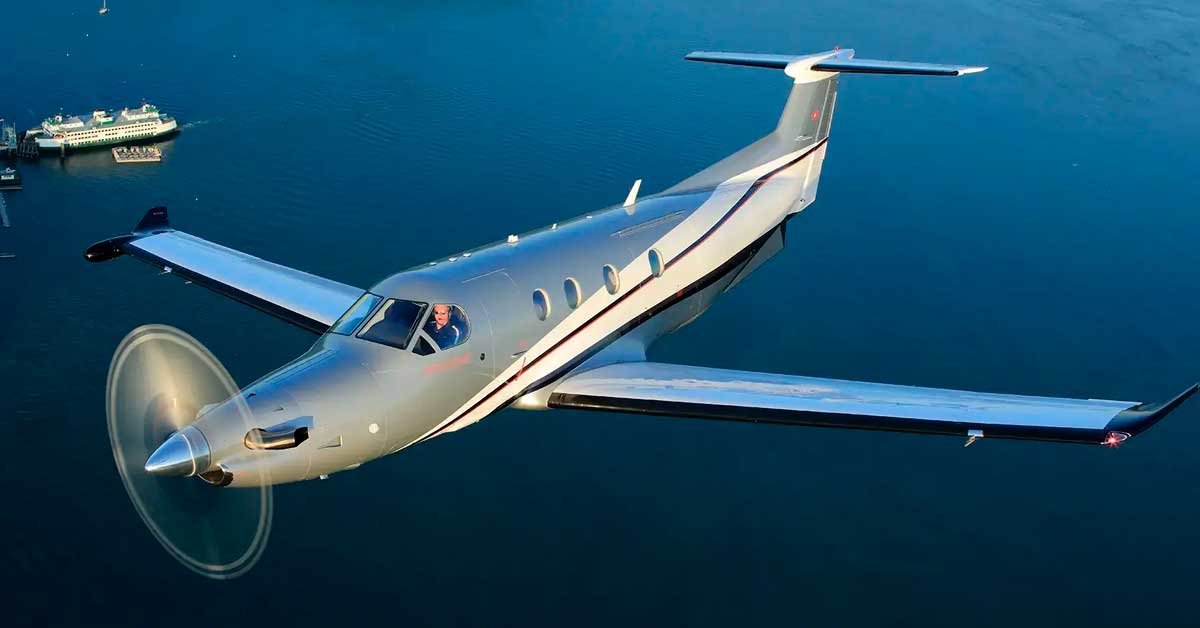
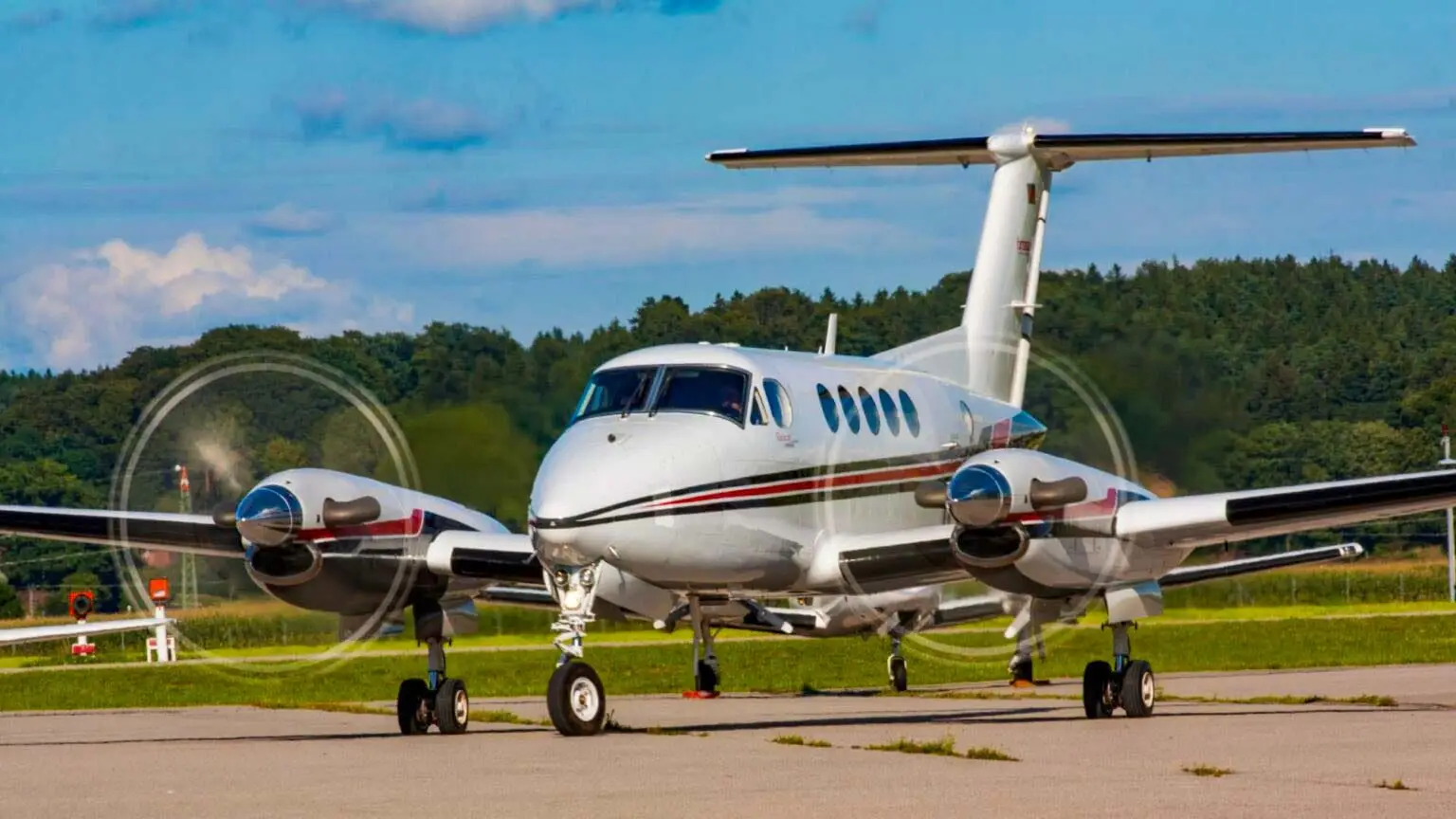
Turboprops such as the Beechcraft King Air B200 and the Pilatus PC-12 are the champions of short, dirt or grass runways and of beach and farm destinations. They fly lower and slower than jets, but burn less fuel, accept runways that jets cannot and have enough range for most regional routes. They are frequent choices for routes such as São Paulo–Angra dos Reis, Belo Horizonte–Trancoso and agribusiness flights.
Light jets: the best value on domestic routes
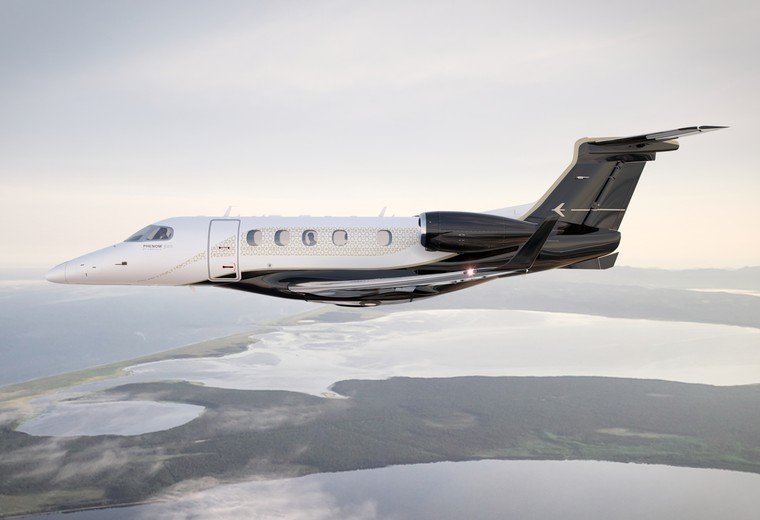
Light jets, such as the Phenom 100, the Citation CJ3 and the Embraer Phenom 300E, carry four to eight passengers on routes of up to two or three hours at jet speed. According to Embraer, the Phenom 300E has been the best-selling light jet for more than a decade and has a range of 2,010 nautical miles, about 3,723 km, with five occupants, under the manufacturer's reference conditions.
Midsize and super-midsize jets: stand-up cabin and continental range
Midsize and super-midsize jets, such as the Embraer Praetor 500 and the Bombardier Challenger 3500, offer a taller cabin, more baggage space and the range to cross Brazil from end to end nonstop or reach South American capitals. They are good choices for teams of six to nine people and for flights of three to five hours.
Large and long-range jets: intercontinental flights
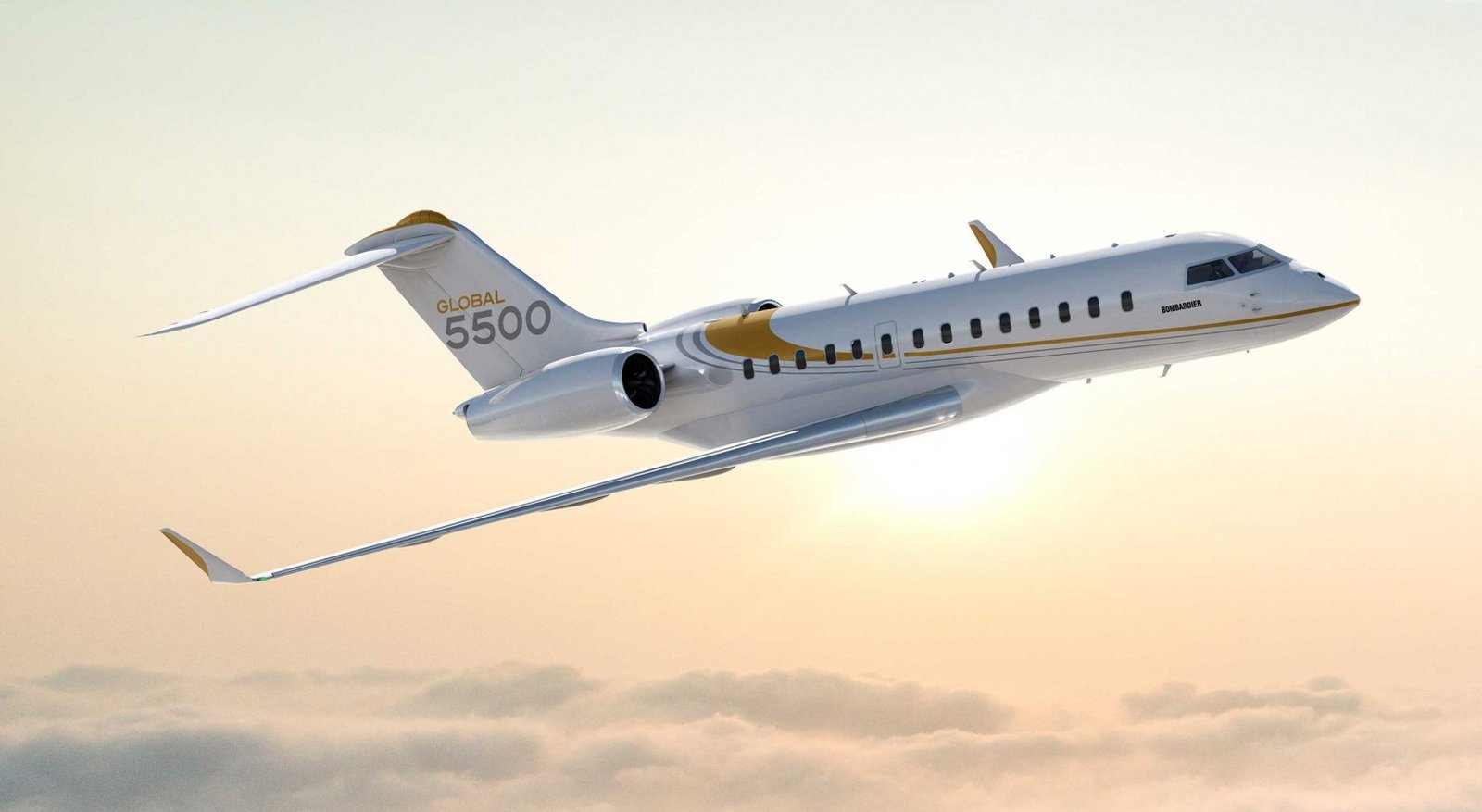
Jets such as the Embraer Legacy 650, the Gulfstream G550 and the Bombardier Global 6500 cross oceans. According to Bombardier, the Global 6500 has a theoretical range of 6,600 nautical miles, or 12,223 km, and carries up to 17 passengers. The longest-range models, such as the Global 6500 and the G550, connect São Paulo to Miami, Lisbon or Paris nonstop, depending on flight conditions; the Legacy 650, with a shorter range, serves long continental routes and shorter ocean crossings.
Helicopters: the last mile
Helicopters such as the Esquilo AS350 and the Airbus H145 cover the short hop between the city center, the airport, the beach house or the farm. Details are in the helicopter section below and in the Executive Helicopter Guide.
Summary by mission
| Typical mission | Recommended category | Passengers (typical) |
|---|---|---|
| Farm, beach or short runway | Turboprop | 4 to 8 |
| State capitals up to 2–3 hours away | Light jet | 4 to 7 |
| Brazil end to end, South America | Midsize or super-midsize jet | 6 to 9 |
| United States, Europe, Africa | Large or long-range jet | 8 to 14 |
| City center and airport | Helicopter | 4 to 8 |
Full technical specifications are available on the aircraft specifications blog, and an in-depth comparison of jets is in the Private Jet Guide.
Most requested aircraft for executive air taxi
 TurboéliceBeechcraft King Air B200Specifications, cabin, performance and charter options.Read more
 Jato · LightEmbraer Phenom 300ESpecifications, cabin, performance and charter options.Read more
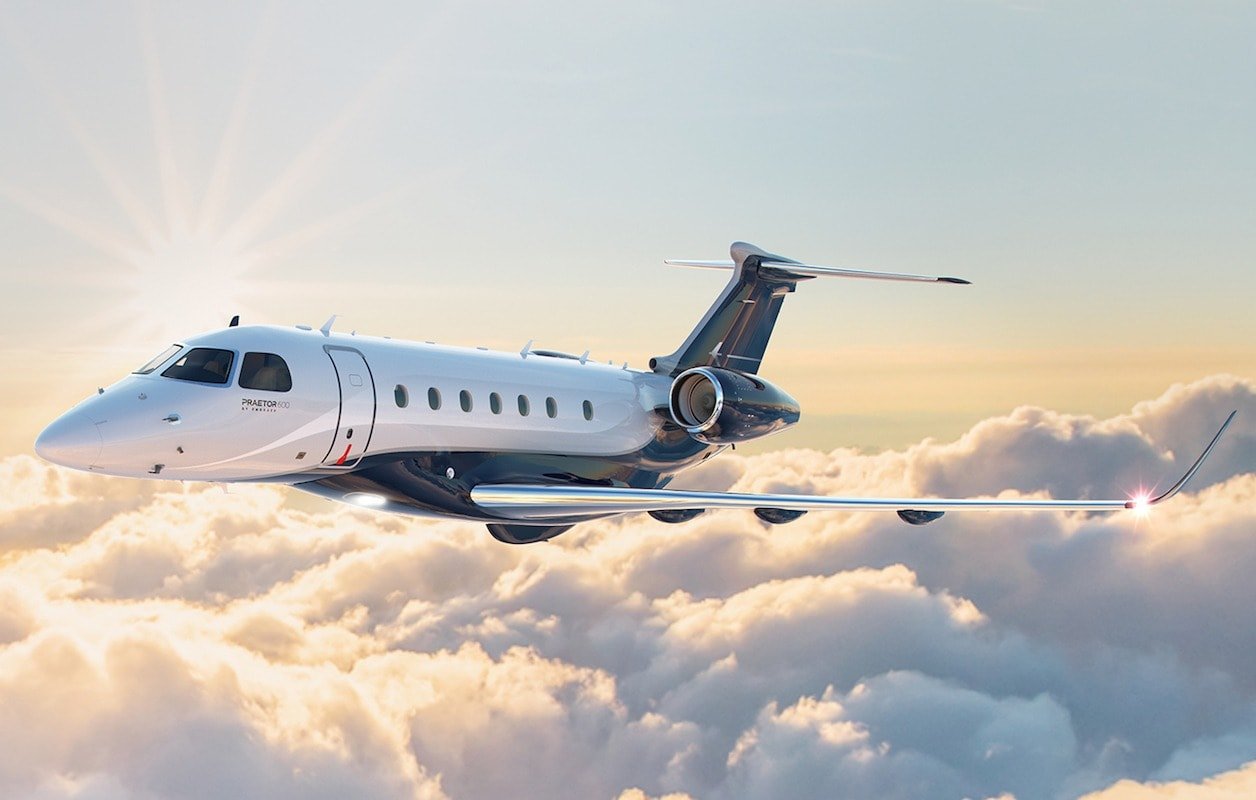 Jato · MidsizeEmbraer Praetor 500Specifications, cabin, performance and charter options.Read more
 Jato · Super-midsizeBombardier Challenger 3500Specifications, cabin, performance and charter options.Read more
 Jato · Long RangeBombardier Global 6500Specifications, cabin, performance and charter options.Read more
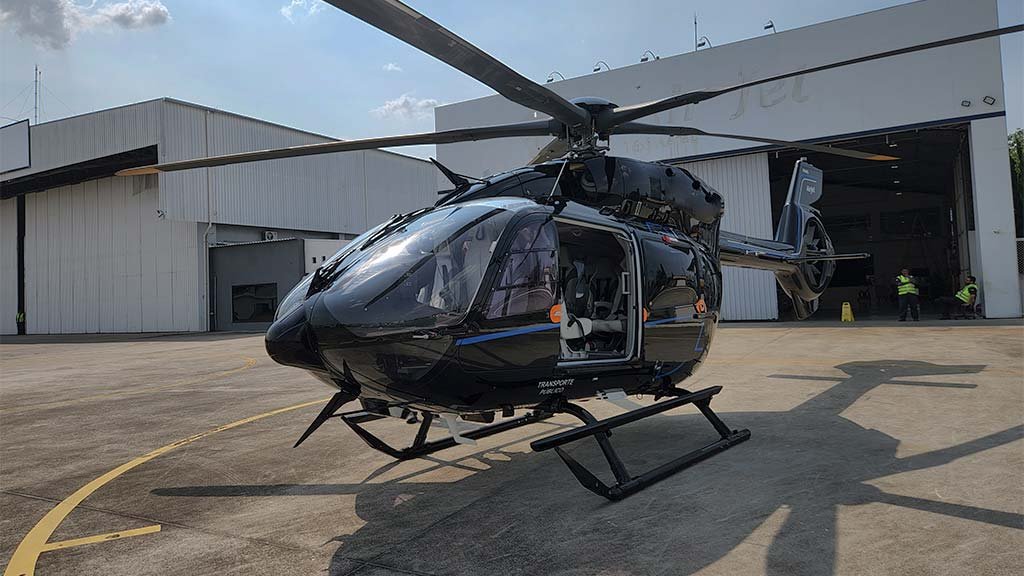 Helicóptero · BimotorAirbus H145Specifications, cabin, performance and charter options.Read more
When is a helicopter the best air taxi choice?
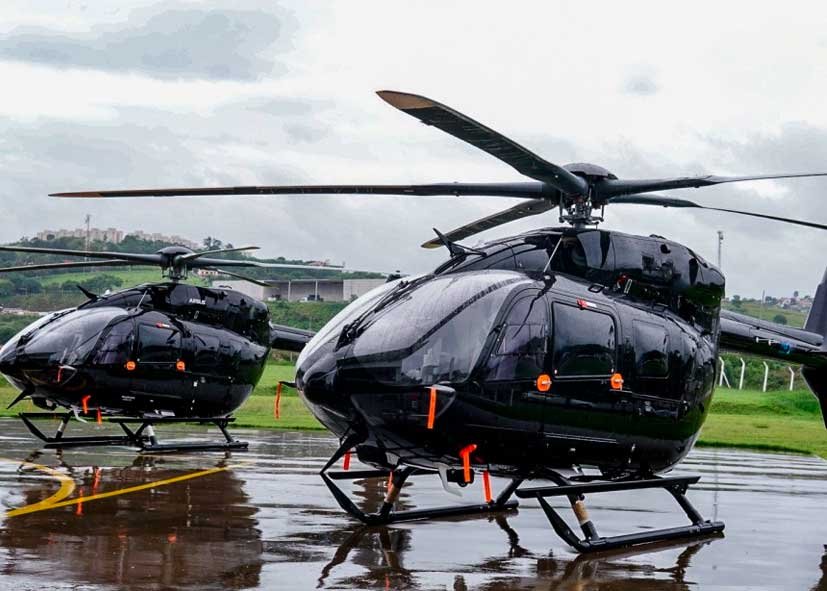
A helicopter is the best air taxi choice when the distance is short but traffic, geography or the lack of a runway makes ground travel slow. In Brazil's major cities, helicopter air taxi connects heliports on office buildings, hotels and residential complexes to airports and leisure destinations in minutes.
Most common uses of the executive helicopter
- Airport transfer: linking a corporate heliport to Guarulhos, Congonhas, Campo de Marte, Catarina or Galeão, connecting with a jet or airline flight.
- Beach and country houses: legs such as São Paulo–North Coast, Rio–Angra dos Reis or São Paulo–Fazenda Boa Vista.
- Agribusiness and industry: visits to farms, mills, construction sites and platforms without a landing strip.
- Events: Grand Prix races, concerts and weddings at hard-to-reach venues.
- Scenic flights: an operation with its own ANAC rules, currently under review in RBAC 136.
Single-engine or twin-engine?
Single-engine helicopters, such as the Esquilo AS350 B2, the Bell 407 and the Airbus EC130 B4, have a lower hourly cost and serve short legs well in good weather. Twin-engine helicopters, such as the Agusta A109E Power and the Airbus H145, offer engine redundancy, a larger cabin and, depending on configuration and certification, instrument flight capability. Many companies require twin-engine helicopters in their travel policies for flights over dense urban areas or over water.
Restrictions that affect helicopter flights
Helicopters depend heavily on weather, because most urban operations are flown under visual flight rules. Low ceilings, heavy rain and reduced visibility can delay or cancel the flight. In addition, each heliport has its own rules: operating hours, maximum helicopter weight, prior authorization requirements and, in some cases, municipal regulations. In August 2026, for example, Rio de Janeiro's city government terminated the Lagoa heliport use agreements of five companies that lacked municipal authorization to sell scenic flights.
How to book a helicopter safely
The same rules that apply to airplanes apply to helicopters: the company must be authorized as an air taxi, and the registration must appear on the RAB linked to an operator authorized to provide 135 service. Ask whether the origin and destination heliports are certified or registered and whether the operator is authorized to land there.
Embarque Oficial organizes executive helicopter transfers and scenic flights with certified operators.
What are the main executive airports and heliports in Brazil, and their restrictions?
The main business aviation airports on the Rio–São Paulo axis are Congonhas (SBSP), Campo de Marte (SBMT), Catarina (SBJH), Jundiaí (SBJD), Guarulhos (SBGR) and Viracopos (SBKP) in São Paulo, and Santos Dumont (SBRJ), Jacarepaguá (SBJR) and Galeão (SBGL) in Rio de Janeiro. Each has different advantages and restrictions in terms of hours, slots, runway and services, and the choice of airport can change the price and feasibility of an executive air taxi flight.
Comparison of executive airports
| Airport | ICAO | Highlight | Watch out |
|---|---|---|---|
| Congonhas (São Paulo) | SBSP | Central, close to Avenida Paulista and Faria Lima | Coordinated airport: requires a slot and, since October 15, 2026, a contracted FBO |
| Campo de Marte (São Paulo) | SBMT | North Zone, major base for helicopters and general aviation | Instrument operations being introduced in a test phase |
| Catarina (São Roque) | SBJH | Dedicated to business aviation, international, 24 hours | About 50 km from the city of São Paulo |
| Jundiaí | SBJD | General aviation and maintenance hub | Shorter runway limits larger jets |
| Santos Dumont (Rio) | SBRJ | Downtown Rio, next to Guanabara Bay | Level 3 coordinated airport under ANAC |
| Jacarepaguá (Rio) | SBJR | Barra da Tijuca, general aviation and helicopters | Short runway for larger jets |
Congonhas: slots and the new FBO requirement
Congonhas is designated a coordinated airport by ANAC, which means landings and takeoffs depend on allocated times, known as slots. According to Aeroin, since October 15, 2026, ANAC has required air taxi and private aircraft operators to contract an FBO before requesting slots at Congonhas, an amendment to Decision No. 533/2022 with the stated aim of curbing the parallel market in slots. In practice, flying to Congonhas requires advance planning, and the operator must confirm the slot before locking in the time with the client.
Campo de Marte: helicopters, jets and IFR
Campo de Marte is managed by PAX Aeroportos under a 30-year concession. According to a July 2026 report, the airport grew from 59,297 operations in 2023 to 66,781 in 2025, with 98,031 projected for 2030, and instrument flight rules (IFR) operations are starting with a test phase limited to four operations per hour. Landing and parking fees are charged by the concessionaire based on the aircraft's maximum takeoff weight.
Catarina and Jundiaí: alternatives outside the city
Catarina Airport, in São Roque, has been operated by JHSF since 2019 and presents itself as Brazil's first international airport dedicated exclusively to business aviation, operating 24 hours a day. Jundiaí Airport, managed by Rede VOA, is a general aviation and maintenance hub with a shorter runway than the major international airports, which favors turboprops and light jets.
Rio de Janeiro: Santos Dumont, Jacarepaguá and Galeão
Santos Dumont is on ANAC's list of level 3 coordinated airports, alongside Congonhas, Guarulhos, Pampulha and Recife, and it is the most central option for travelers heading downtown or to the South Zone. Jacarepaguá, also operated by PAX Aeroportos, serves Barra da Tijuca and has heavy helicopter traffic. Galeão, the international airport, is the option for large jets and flights abroad.
Heliports
Heliports are located on office buildings, hotels, shopping malls, hospitals and residential complexes. Each has its own rules on operating hours, maximum weight and prior authorization. Always confirm with the operator that the heliport can receive the quoted model. Itineraries and destinations are collected on the destinations page.
- Slot confirmed at coordinated airports such as Congonhas
- FBO or VIP lounge arranged for boarding
- Destination runway compatible with the aircraft
- Airport or heliport operating hours checked
How do international executive air taxi flights and flights to South America work?
An international air taxi flight departing Brazil requires three things: an operator authorized to fly abroad, an airport with border control at departure and arrival, and passenger, crew and aircraft documents in order. South America is the most accessible international market for Brazilian executive charter, with destinations such as Punta del Este, Buenos Aires, Montevideo, Santiago, Asunción, Lima and Bariloche within reach of midsize jets and, in some cases, of light jets and turboprops with a stop.
International clearance: customs, immigration and health
International flights depart from and arrive at international airports, where the Receita Federal (Brazil's federal revenue and customs service), the Federal Police and the health and agricultural authorities operate. In business aviation, these procedures are handled at general aviation terminals or through FBOs, which organize the passage of passengers and crew through the controls. Goods subject to declaration must be reported to the Receita Federal through the e-DBV (electronic traveler's goods declaration), as on any international trip. The operator also files the international flight plan and obtains the overflight and landing permits required by the countries involved.
Operator authorizations
Not every air taxi company may fly outside Brazil. The Operations Specifications define whether the operator is authorized for international operations and with which aircraft. Ask about this when requesting a quote, especially for destinations outside South America. In the opposite direction, foreign companies that want to conduct non-scheduled air transport to or from Brazil follow ANAC Resolution No. 692/2022, which requires registration and, depending on size, an Air Operator Certificate, with an exemption for aircraft with up to 19 seats and for helicopters in some cases. The same resolution treats operations by a foreign company between two points within Brazil as exceptional.
Documents for flying abroad
- A valid passport; for Mercosur and associated countries, a national ID card may be accepted, according to each country's rules.
- Visas and electronic travel authorizations when required by the destination.
- Travel authorization for minors in accordance with the ECA and CNJ Resolution No. 131.
- Health certificates for pets, according to the destination country.
Long-range routes
For the United States, Europe, the Middle East and Asia, charter requires long-range jets such as the Global 6500 or the Gulfstream G550. In a survey published in 2026, Flapper cited a quote of around R$ 2.72 million for a São Paulo–Shanghai flight on a Gulfstream G550, an estimate that shows the cost scale of intercontinental routes. On very long routes, the choice between flying nonstop or making a fuel stop affects price, time and comfort.
Embarque Oficial organizes flights to South America and intercontinental flights, supported by its network of offices in Monaco, Dubai, London, Paris, Liverpool, Fort Lauderdale, New York, Las Vegas and Shanghai for logistics at the destination. The offices coordinate operations behind the scenes; client service is provided via the web, via WhatsApp and in person at boarding, at heliports and airports.

- Operator authorized for international flights
- Departure and arrival airports with border control
- Passports, visas and minors' authorizations up to date
- Goods declared to the Receita Federal when required
Safety, RETA insurance and responsibilities: what should passengers know?
Air taxi safety depends on a chain of responsibilities: ANAC certifies and oversees, DECEA controls the airspace, the RBAC 135 operator is responsible for operations, maintenance and crew, and the mandatory RETA insurance guarantees compensation to passengers and third parties in the event of an accident. Anyone booking an executive air taxi should understand each of these pieces.
What RETA insurance is
RETA (Seguro Obrigatório de Responsabilidade Civil do Explorador ou Transportador Aéreo) is the mandatory civil liability insurance for aircraft operators and air carriers, provided for in the Brazilian Aeronautical Code (Código Brasileiro de Aeronáutica) and currently regulated by Resolution No. 442/2022 of the CNSP (Conselho Nacional de Seguros Privados), Brazil's National Council of Private Insurance, which revoked CNSP Resolution No. 355/2017 and took effect on September 1, 2022. RETA covers the ANAC-authorized operator or carrier when it must compensate third parties for damage occurring during a trip. The rule sets out six basic coverages, mandatory depending on the type of aircraft and operation:
- bodily injury to passengers;
- bodily injury to crew members;
- damage to third parties and property on the ground;
- civil liability for collision;
- damage to cargo and checked baggage;
- boarding delays of more than four hours, applicable to scheduled transport.
Each coverage has its own maximum indemnity limit, and the policy is taken out with no deductible for third-party compensation. In air taxi, baggage coverage is mandatory when the operation is identified in the Operations Specifications.
Why an illegal flight is an insurance risk
Aviation policies are issued based on the aircraft's declared purpose and authorized operation. A private aircraft used for paid transport operates outside what was declared, which opens the door to coverage disputes precisely when the passenger's family needs that coverage most. That is why checking the company and the registration before the flight is also financial protection.
Responsibilities of each party
| Party | Main responsibility |
|---|---|
| ANAC | Certify, authorize and oversee companies, aircraft and crew |
| DECEA | Airspace control, flight plans and navigation charges |
| RBAC 135 operator | Safe operation, maintenance, crew, RETA insurance and contract of carriage |
| Pilot in command | Final decision to take off, divert or cancel for safety |
| Passenger | Provide accurate information, follow the briefing and not pressure the crew |
The authority of the pilot in command
The pilot in command has the final say on flight safety. If the captain decides not to take off because of weather, runway limitations or weight, that decision must be respected. One of the recurring causes of general aviation accidents is pressure to keep to a schedule in unsuitable conditions. Well-drafted contracts specify what happens to the amount paid when a flight is canceled for safety reasons.
Safety best practices
- Prefer operators with a mature safety management system and a transparent track record.
- For night flights or unstable weather, ask whether the aircraft and crew are qualified for instrument flight.
- For helicopters over dense urban areas or over water, consider twin-engine models.
- Follow the safety briefing and keep your seat belt fastened.
For aircraft owners who want to understand how insurance, maintenance and crew factor into the cost, the Aircraft Management Guide covers the subject in depth.
- Operator's RETA insurance in force
- Passenger and baggage coverage confirmed
- Pilot in command's authority respected
- Safety cancellation clause in the contract
Executive air taxi for companies: roadshows, corporate programs and the Jet Card
For companies, an executive air taxi is a productivity tool: the same executive who would spend two days on airline connections can visit three cities and be home the same day. The challenge is turning one-off flights into a predictable travel policy, with controlled costs and clear safety criteria.
Roadshows
On a roadshow, such as a share offering, a fundraising round or a product launch, the schedule is tight and leaves no room for delays. Charter makes it possible to fit meetings in São Paulo, Rio, Belo Horizonte and Brasília into one or two days, with the aircraft waiting between appointments. For international roadshows, a midsize or long-range jet can link São Paulo, New York and London in sequence. Embarque Oficial puts together aerial roadshows with planning for slots, FBOs, ground transportation and a plan B.
Corporate programs
Companies that fly frequently benefit from centralizing bookings. A corporate program defines aircraft by mission type, minimum safety criteria, such as twin-engine helicopters and two-pilot crews, internal approval rules and usage reports by cost center. This shortens quoting time and prevents each department from booking in its own way.
Jet Card: prepaid hours
The Jet Card is a prepaid flight hour program with a set hourly rate for the contracted aircraft category. According to Forbes, in a 2026 report on the U.S. market, these programs usually require a minimum purchase, often 25 hours a year or more. The advantages are price predictability, guaranteed availability within agreed lead times and less paperwork for each flight. The Embarque Oficial Jet Card is structured with ANAC-certified operators; it is worth comparing the rules on advance notice, peak dates and positioning charges before joining.
When buying an aircraft starts to make sense
Charter, the Jet Card, shared ownership and aircraft ownership are steps on the same ladder. The more hours flown per year and the more predictable the schedule, the more the math tips toward owning an aircraft. Before making that decision, it is worth studying aircraft sales and acquisition, financing options and operating costs.
Best practices for the travel policy
- Define who may approve charter flights and in which situations.
- Require an RBAC 135 operator and a registration check for every booking.
- Set minimum safety criteria by aircraft category.
- Centralize invoices and reports to compare cost per passenger and per hour saved.

- Approval policy for charter flights defined
- Minimum safety criteria by aircraft type
- One-off charter compared with the Jet Card
- Usage reports by cost center
Glossary: key executive air taxi terms
- Air taxi (táxi aéreo)
- Non-scheduled public air transport service in which the client hires the entire aircraft, with crew. In Brazil, it may only be provided by a company certified by ANAC.
- Charter (fretamento)
- Hiring an entire aircraft for one flight or a series of on-demand flights. It is the most widely used commercial term for the air taxi service.
- RBAC 135
- ANAC regulation setting the operating requirements for commuter and on-demand operations, the basis for air taxi companies in Brazil.
- RBAC 91
- Regulation with the general operating rules for civil aircraft, governing private aviation without the sale of transport to third parties.
- COA
- Certificado de Operador Aéreo, the Air Operator Certificate issued by ANAC at the end of certification. Without it, a company cannot sell air transport.
- Operations Specifications
- Document (Especificações Operativas) accompanying the COA that defines the aircraft, areas and types of operation authorized for each company.
- Service 135 (RAB)
- Digital RAB field that, since January 1, 2026, shows whether the aircraft is linked to an operator authorized to provide air taxi under RBAC 135. It replaced the old registration categories, such as TPX, abolished by ANAC Resolution No. 739/2024.
- RAB
- Registro Aeronáutico Brasileiro (Brazilian Aeronautical Registry), ANAC's public register showing the owner, operator and status of each aircraft by registration mark.
- TACA
- Acronym used in the Brazilian industry for clandestine air transport: the sale of flights by anyone without ANAC authorization.
- RETA
- Mandatory civil liability insurance for aircraft operators and air carriers in Brazil, regulated by CNSP Resolution No. 442/2022.
- Empty leg
- A leg on which the aircraft would fly empty, sold at a discount as an opportunity flight, with a preset date and route.
- Positioning
- A flight without passengers to bring the aircraft to the client's origin or return it to base. It is usually included in the charter price.
- Overnight (pernoite)
- Cost of crew lodging, meals and per diem when the aircraft spends the night away from base.
- FBO
- Fixed Base Operator, a ground services provider for business aviation, with a passenger lounge, crew support and dispatch.
- Slot
- An allocated landing or takeoff time at a coordinated airport, such as Congonhas and Santos Dumont.
- Jet Card
- A prepaid flight hour program with a set hourly rate for an aircraft category.
Frequently asked questions about executive air taxi
What is an executive air taxi?
An executive air taxi is the charter of an entire aircraft, with crew, to fly on the route and at the time the client chooses. In Brazil, the service is non-scheduled public air transport and may only be sold by companies certified by ANAC under RBAC 135, with aircraft linked in the RAB (Brazilian Aeronautical Registry) to an operator authorized to provide 135 service and covered by RETA insurance.
What is the difference between an air taxi and a private jet?
A private jet flies under RBAC 91 for its owner's use and cannot be hired out with a pilot to carry third parties for payment. An air taxi is operated by an ANAC-certified company under RBAC 135 and may sell the flight. In Brazil, when a private aircraft is hired out with crew, the flight is clandestine and illegal.
How can I tell whether an air taxi company is authorized by ANAC?
Use Voe Seguro, ANAC's free tool available on the agency's website and as an app for Android and iOS. It shows whether the air taxi company is authorized and whether the aircraft is cleared for air taxi. Complement it by looking up the registration in the Brazilian Aeronautical Registry (RAB).
How do I look up an aircraft's registration on the RAB?
Ask the operator for the registration, such as PR-XXX or PT-XXX, and look it up in the Brazilian Aeronautical Registry (RAB) on ANAC's website. Check that the aircraft shows as authorized to provide 135 service, that its airworthiness is normal and that the operator is the company that signed the contract. A suspended certificate or an expired CVA are reasons not to board.
What is TACA and why is it dangerous?
TACA is clandestine air transport in Brazil: the sale of flights by anyone without ANAC authorization, usually using a private aircraft. Such a flight is not subject to the oversight required for air taxi, may have insurance coverage problems and exposes those responsible to fines that, following an amendment to ANAC Resolution No. 472/2018, can reach R$ 200,000.
How much does it cost to charter a private jet in Brazil?
There is no official price table. The cost of private jet charter in Brazil depends on the aircraft's hourly rate, positioning, overnights, fees and waiting time. As an estimate, quotes published by Flapper in 2026 show São Paulo–Belo Horizonte at between R$ 52,540 and R$ 80,120 on light and midsize jets. Only an all-inclusive quote is reliable.
What is charged in addition to the hourly rate?
In addition to the hourly rate, an air taxi quote may include aircraft positioning, the empty return to base, crew overnights and per diems, landing and parking fees charged by airports, navigation charges passed on to DECEA, waiting time and onboard catering. Ask for a proposal with each item listed separately and the total price in writing.
Is a one-way flight cheaper than a round trip?
Not always. On a one-way air taxi flight, the aircraft usually returns empty to base, and that return is built into the price. On a round trip, the aircraft waits at the destination, and the cost then includes overnights or waiting time. The operator should compare both options and show the most economical one for your schedule.
What is an empty leg?
An empty leg is a leg that an aircraft would fly empty, for example when returning to base after dropping off a client. The operator sells that leg at a discount, with the same aircraft, crew and RBAC 135 standard. In return, the passenger accepts a preset date, time and route and the risk of changes if the main flight is altered.
Can I bring my dog on an air taxi?
In many cases, yes. Whether pets are accepted in the cabin of an air taxi depends on the operator's policy and the aircraft model. Specify species, size and number in the quote request. On international flights, the animal must meet the health requirements of the destination country and the rules for returning to Brazil.
Can a minor fly on an air taxi without their parents?
It depends on age and destination. Under Brazilian Law No. 13.812/2019, which amended Article 83 of the ECA (Child and Adolescent Statute), children under 16 need authorization to travel within Brazil without their parents or guardians, except in the cases provided by law. For international travel, the ECA and CNJ Resolution No. 131 apply. The air taxi operator may refuse boarding without the documentation.
How much baggage can I bring on a business jet?
Baggage on business aircraft is limited by volume and weight, because total weight affects fuel and range. Light jets and turboprops have smaller holds, and soft-sided bags fit better. In the quote request, state the number of bags and bulky items, such as golf clubs or surfboards, so the operator can recommend the right aircraft.
What documents do I need to fly on an air taxi?
On domestic air taxi flights in Brazil, each passenger presents an official photo ID, and the operator asks for names in advance for the manifest. On international flights, a valid passport or a document accepted within Mercosur, visas where required and travel authorizations for minors are needed. Goods subject to declaration follow the rules of the Receita Federal, Brazil's customs service.
Which aircraft should I choose for my trip?
Choose the smallest aircraft that completes the mission with comfort and margin. Turboprops serve short runways and farms; light jets cover state capitals up to two or three hours away; midsize and super-midsize jets cross Brazil and reach South America; long-range jets fly intercontinental routes; helicopters handle short urban hops.
Can I fly a business jet into Congonhas?
Yes, but São Paulo's Congonhas is a coordinated airport under ANAC and requires a slot. Since October 15, 2026, air taxi and private aircraft operators must contract an FBO before requesting slots. Flights to Congonhas therefore need advance planning; Campo de Marte, Catarina and Jundiaí are alternatives in the São Paulo area.
Does Catarina Airport handle international flights?
Yes. Catarina Airport, in São Roque, about 50 km from the city of São Paulo, has been operated by JHSF since 2019 and presents itself as Brazil's first international airport dedicated exclusively to business aviation, operating 24 hours a day. It is an option for international business flights in the São Paulo area.
Can a Brazilian air taxi fly to other countries?
Yes, provided the company's Operations Specifications authorize international operations with that aircraft. The flight departs and arrives through airports with border control, and the operator obtains overflight and landing permits from the countries involved. Ask about this authorization when requesting a quote, especially for destinations outside South America.
What is RETA insurance and what does it cover?
RETA is Brazil's mandatory civil liability insurance for aircraft operators and air carriers, regulated by CNSP Resolution No. 442/2022. It covers compensation to passengers, crew, third parties on the ground, collisions and baggage, depending on the type of operation. In a legal air taxi, the certified operator is the one that takes out and maintains RETA coverage.
What is a Jet Card and is it worth it?
A Jet Card is a prepaid flight hour program with a set hourly rate for an aircraft category. It is worthwhile for those who fly several times a year and want predictable pricing and availability. Compare the required advance notice, peak dates, positioning charges and the RBAC 135 operator responsible for the flights.
How do I request an executive air taxi quote from Embarque Oficial?
Send the origin, destination, dates, times, number of passengers, baggage and special items through the contact page. Embarque Oficial organizes the executive air taxi flight with ANAC-certified air taxi operators, presents the aircraft and registration for verification and follows the trip through to arrival, in Brazil and abroad.
Sources and references
- Aeroin: Frota de táxi-aéreo no Brasil cresce 5,6% (jul/2026)
- Forbes Brasil: Brasil chega a 11 mil aeronaves executivas (jul/2026)
- Forbes Brasil: Quanto custa viajar de jato particular (ago/2026)
- Flapper: How much it costs to charter a private jet in 2026
- gov.br: Obter autorização para explorar serviços aéreos públicos (RBAC 135)
- ANAC: Resolução nº 659/2022
- Agência Gov: Voe Seguro, aplicativo da ANAC para táxi aéreo (jan/2024)
- Legismap: mudanças nos campos de categoria de aeronaves no RAB digital (Resolução ANAC nº 739/2024)
- SNA: ANAC multiplica por 10 o valor das multas para táxi aéreo clandestino
- Agência Gov: ANAC intensifica fiscalização de voos panorâmicos no Rio (ago/2026)
- Legismap: Resolução CNSP nº 442/2022 (seguro RETA)
- Aeroin: ANAC exige FBO para slots de jatos executivos em Congonhas (out/2026)
- ANAC: Slot coordination (aeroportos coordenados)
- Correio da Manhã: Campo de Marte projeta ampliar voos até 2052 (jul/2026)
- PAX Aeroportos: Política de Tarifação (Campo de Marte e Jacarepaguá)
- Bloomberg Línea: JHSF quer aval para voos comerciais no Catarina
- Lex: Resolução ANAC nº 692/2022
- AASP: Lei 13.812/2019 altera idade para menores viajarem sozinhos
- Embraer: Phenom 300E brochure 2025
- Bombardier: Global 6500 factsheet
Guide written by Régis Hahns, CEO of Embarque Oficial, with the company's editorial team, based on the sources above. Rules, prices and lead times change: always confirm with ANAC, the manufacturer or a specialist before deciding. Embarque Oficial serves clients worldwide, from Monaco, Dubai, Capri and Rome to every region of Brazil, and arranges each flight with operators certified by ANAC, Brazil's civil aviation authority, in Brazil and by the local aviation authority abroad.
Keep exploring the Knowledge Hub
 Complete guidePrivate Jets GuideCategories, range, cabin, costs and how to choose the right jet for each mission.Read moreComplete guideExecutive Helicopters GuideModels, single vs. twin engine, helipads and urban mobility by helicopter.Read moreComplete guideAircraft Acquisition GuideEvaluation, pre-purchase inspection, contracts, ANAC registration and pitfalls.Read more
 Complete guideAircraft Management GuideCosts, maintenance, crew, compliance and how to lower the cost per flight hour.Read more
 Complete guideBusiness Aviation GuideThe sector in Brazil and worldwide: market, rules, technology and trends.Read moreEmbarque Oficial serviceExecutive Air TaxiFlight quotes with ANAC-certified operators, in Brazil and abroad.Read more
Ready to fly
Tell us where, we take care of the rest
Confidential quotes and 24/7 support, every day of the year.
WhatsApp +55 48 98877-0541 · sales@embarqueoficial.com