
Complete Guide · Private Jets
Private jets guide: categories, costs and how to choose
From the very light jet to the ultra long range, this guide compares the passengers, range, cabin and costs of private jets using manufacturer data, so you can choose the right jet for each mission, in Brazil and beyond.
By Régis Hahns, CEO of Embarque Oficial · LinkedIn
- 2011flying since
- 50 minread
- 20sources cited
What is a private jet?
A private jet, or business jet, is a jet aircraft used for exclusive, on-demand transport of a small number of people, with the schedule and route set by the passenger. Private jets range from the very light jet, for four to six passengers on short legs, to the ultra long range, which flies more than 13,000 km nonstop. In Brazil, travelers who do not own an aircraft fly private jets through charter with air taxi companies certified by ANAC (Agência Nacional de Aviação Civil), Brazil's civil aviation authority, choosing the category according to the mission.
In this guide
- What is a private jet and how does it differ from commercial aviation?
- What are the private jet categories?
- Very light, light and midsize: which private jets serve regional flights?
- Super-midsize and large: when the business jet becomes an international tool
- Long range, ultra long range and bizliners: private jets that cross oceans
- Jet, turboprop or helicopter: which aircraft makes the most sense?
- What is a business jet cabin like: height, lavatory, galley, bed and Wi-Fi
- Brochure range vs real range: why doesn't a jet always fly what the catalog says?
- How much do private jets cost? Charter and ownership by category
- How do you choose the right jet for each mission?
- Which business jet manufacturers and models are in production in 2026?
- Crew and regulations: who can operate a business jet in Brazil?
- Sustainability and technology: SAF, Autoland and the new cabins
- Glossary
- Frequently asked questions
What is a private jet and how does it differ from commercial aviation?
A private jet, also called an executive jet, a business jet or, in Brazil, a jatinho, is an aircraft powered by turbofan engines and designed to carry a small number of people on demand, with the schedule, origin and destination set by the passenger. A business jet does not sell seats on a network of scheduled flights the way commercial aviation does: it flies when the client needs it, from airports and general aviation terminals, often with boarding in a few minutes and no connections.
The term private jet describes the type of aircraft and the type of experience. The legal framework of the flight, however, depends on who operates the aircraft. In Brazil, the same jet model can fly as a private aircraft, used by its own owner, or as an air taxi aircraft, which sells the flight to third parties through charter. This difference is decisive for anyone booking a flight and is explained in detail later in this guide.
Private jet, business jet, charter: the right terms
- Private jet (jato privado or jato particular): a jet aircraft used for exclusive transport, with no seats sold to the public.
- Business jet or executive jet: the name manufacturers use for the family of jets designed for business aviation, from the very light jet to the ultra long range.
- Charter (fretamento): hiring the entire flight from an air taxi operator, which provides the aircraft, crew, maintenance and insurance.
- General aviation and business aviation: the set of civil operations that are not scheduled airlines, of which business aviation is the segment serving business and high-end leisure travel.
Why companies and families use private jets
The main reason is time. A business jet can take off from airports that have no scheduled service, avoid connections and cut hours of travel from itineraries that cover several cities in the same day. Second comes privacy: meetings, documents and conversations stay inside the cabin. Third is the flexibility to change times, add a stop or carry non-standard baggage. For families, private jets simplify travel with children, older relatives and pets, always according to the operator's rules.
- Business itineraries: visits to plants, branches and clients in cities without direct flights.
- Roadshows and events: several meetings in different cities in one or two days.
- High-end leisure: beach, mountain and resort destinations with nearby airfields.
- International missions: nonstop flights to the United States, Europe or South America.
The business jet market in Brazil in 2026
According to ABAG (Associação Brasileira de Aviação Geral), the Brazilian General Aviation Association, Brazil is the second-largest business aviation market in the world, behind only the United States. Based on ANAC data compiled by the association, the Brazilian business aviation fleet reached 11,362 operational aircraft in May 2026, up from 10,893 in May 2025. Business jets led the growth: there were 1,060 in May 2025 and 1,193 in May 2026, an increase of 12.5%. Over the same period, the turboprop fleet grew 7.6% and the turbine helicopter fleet grew 7.1%.
To understand the sector as a whole, including airports, rules and trends, see the Business Aviation Guide. If you need to fly now, Embarque Oficial arranges air taxi flights in Brazil with ANAC-certified operators, from choosing the jet category to coordinating boarding.

- A private jet is the type of aircraft; air taxi is the legal way to sell the flight
- Charter books the entire flight, not individual seats
- According to ABAG, Brazil is the world's second-largest business aviation market
- Brazil's jet fleet grew 12.5% between May 2025 and May 2026
What are the private jet categories?
Private jet categories are a market convention used by manufacturers, operators and brokers to group aircraft of similar size, cabin and range. There is no official ANAC or FAA classification with these names, so the same model may appear in neighboring categories depending on the source. The most useful criterion for passengers combines three factors: how many people the cabin carries comfortably, how far the jet flies nonstop and what runway length it needs.
The tables below use data published by the manufacturers for current models. Brochure range is theoretical, calculated with few passengers, NBAA IFR standard fuel reserves and the ISA standard atmosphere. In practice, usable range is usually shorter, as explained in the section on real range.
Comparison table of business jet categories
| Category | Typical passengers | Approximate range | Cruise speed | Typical takeoff runway (MTOW) |
|---|---|---|---|---|
| Very light jet | 4 to 6 | up to about 2,865 km (1,547 nm) | about 420 ktas (780 km/h) | about 1,130 m |
| Light jet | 6 to 9 | about 3,700 km (2,000 to 2,010 nm) | 440 to 464 ktas (815 to 860 km/h) | 940 to 980 m |
| Midsize | 7 to 9 | 3,590 to 6,190 km (1,940 to 3,340 nm) | 441 to 466 ktas (815 to 865 km/h) | about 1,290 m |
| Super-midsize | 8 to 12 | 6,300 to 7,440 km (3,400 to 4,018 nm) | Mach 0.80 to 0.84 (up to 483 ktas) | 1,440 to 1,475 m |
| Large or heavy | 10 to 14 | 7,780 to 9,820 km (4,200 to 5,300 nm) | Mach 0.85 (high-speed: 0.88 to 0.90) | 1,500 to 1,750 m (estimate) |
| Long range | 12 to 17 | about 12,200 km (6,600 nm) | Mach 0.85 to 0.90 | 1,700 to 1,900 m (estimate) |
| Ultra long range | 13 to 19 | 13,890 to 15,190 km (7,500 to 8,200 nm) | Mach 0.85 to 0.90 (max. 0.925 to 0.95) | about 1,760 m |
| Bizliner | 15 or more, in VIP layout | varies widely by model | similar to commercial jets | generally longer (estimate) |
Reference models for each row: very light, the HondaJet Elite II; light, the Embraer Phenom 300E and the Pilatus PC-24; midsize, the Cessna Citation Ascend and the Embraer Praetor 500; super-midsize, the Bombardier Challenger 3500, the Cessna Citation Longitude, the Gulfstream G300 and the Embraer Praetor 600; large, the Gulfstream G400 and G500; long range, the Gulfstream G600; ultra long range, the Bombardier Global 7500 and Global 8000, the Gulfstream G700 and G800 and the Dassault Falcon 10X. Runway ranges marked as estimates vary by model and configuration.
Example models and typical mission by category
| Category | Example models | Typical mission from São Paulo |
|---|---|---|
| Very light | Embraer Phenom 100EV, HondaJet Elite II | Rio de Janeiro, Belo Horizonte, Florianópolis, Curitiba |
| Light | Embraer Phenom 300E, Cessna Citation CJ3 and CJ4, Pilatus PC-24 | Brasília, Salvador, Buenos Aires, Punta del Este |
| Midsize | Cessna Citation Ascend and Latitude, Embraer Praetor 500 | Brazil's Northeast, Manaus, Santiago, with a taller cabin |
| Super-midsize | Bombardier Challenger 3500, Citation Longitude, Embraer Praetor 600, Gulfstream G300 | Lima, Bogotá, the Caribbean and Miami in favorable conditions |
| Large | Bombardier Challenger 650, Gulfstream G400 and G500, Dassault Falcon 2000 and 6X | Miami and New York with more margin |
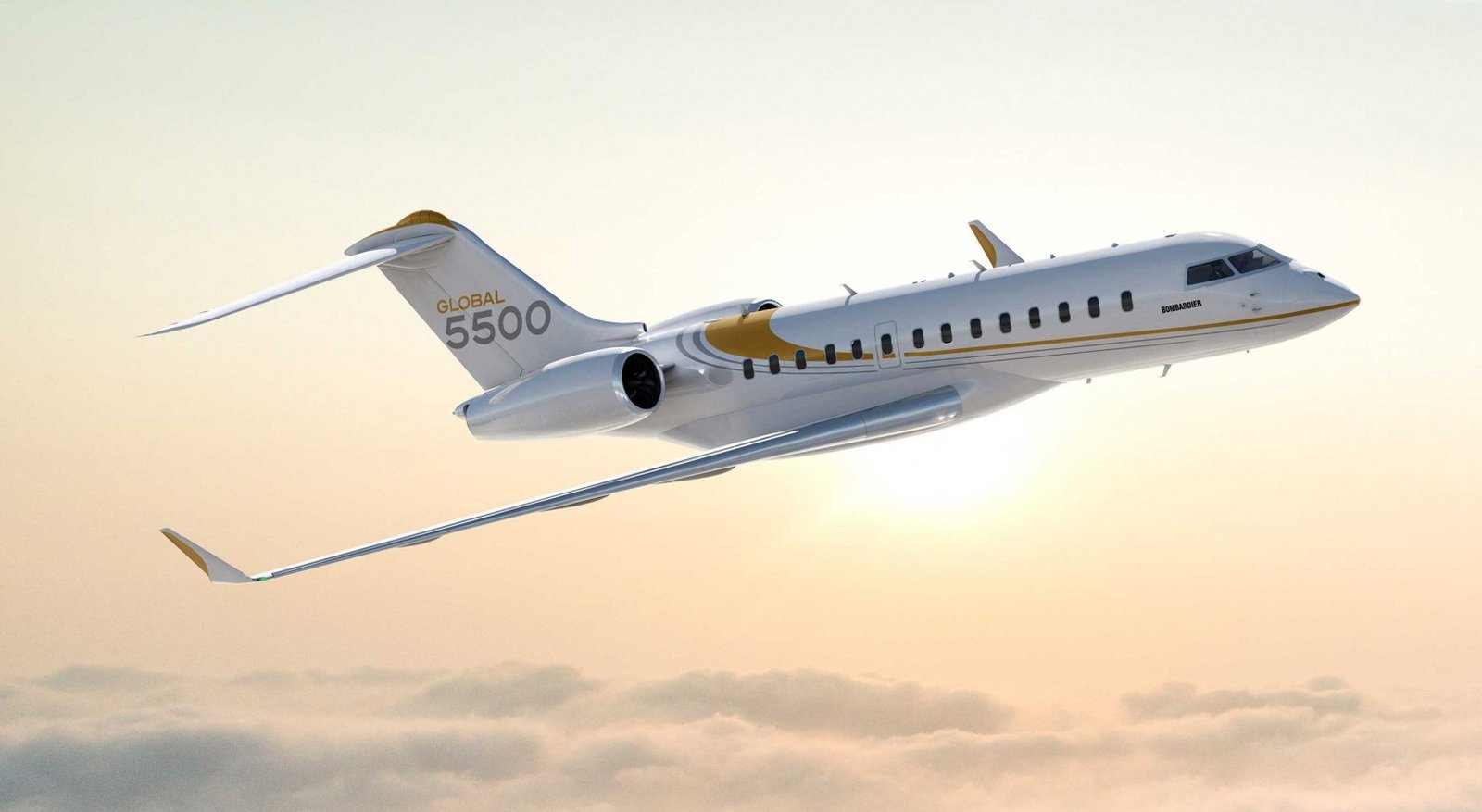
| Long range | Bombardier Global 5500 and 6500, Gulfstream G600, Dassault Falcon 8X | Western Europe nonstop |
| Ultra long range | Bombardier Global 7500 and 8000, Gulfstream G700 and G800, Dassault Falcon 10X | Middle East, US West Coast, missions of more than 12 hours |
| Bizliner | Airbus ACJ TwoTwenty and the ACJ family, Boeing Business Jets | Large delegations and cabins with several zones |
How to read the table without falling into traps
A business jet category is a starting point, not a guarantee. A modern super-midsize may fly farther than an older-generation large jet, and a well-configured light jet may suit a short runway better than a midsize. That is why the final choice always cross-checks the number of passengers, baggage weight, the real route distance, the airport runways and the time of year. Full specifications for each model are available in Embarque Oficial's aircraft technical sheets.
- Category is a market convention, not an official classification
- Compare passengers, range and runway at the same time
- Brochure range assumes few passengers and a standard atmosphere
- New models can outperform larger categories from an older generation
Very light, light and midsize: which private jets serve regional flights?
Very light, light and midsize jets are the entry point to jet-powered business aviation and account for most charter flights within Brazil. They combine a lower hourly cost, access to shorter runways and jet speed, which makes them ideal for legs of up to three or four hours.
Very light jets: Phenom 100EV and HondaJet Elite II
The very light jet is the smallest business jet on the market. The cabin usually seats four to six passengers, without standing headroom, and the focus is efficiency on short and medium legs. According to Aviation Week, the HondaJet Elite II has a range of 1,547 nautical miles (about 2,865 km) with four occupants and NBAA IFR reserves, a maximum cruise speed of 422 ktas at 30,000 feet and a takeoff distance of 3,699 feet (about 1,130 m) at maximum weight. The HondaJet accommodates one or two pilots and has its engines mounted over the wings, a solution that frees up interior space. The HondaJet and the Embraer Phenom 100EV are well suited to routes such as São Paulo–Rio de Janeiro, São Paulo–Florianópolis and São Paulo–Belo Horizonte.
Light jets: Phenom 300E, Citation CJ3 and CJ4, Pilatus PC-24
The light jet is one of the best-selling segments in business aviation. The Embraer Phenom 300E, built in Brazil, is the leading example: according to Embraer's 2025 brochure, it carries 6 to 10 passengers depending on configuration, flies 2,010 nautical miles (3,723 km) with five occupants, reaches 464 knots (859 km/h) in high-speed cruise and needs 3,209 feet (978 m) of runway at maximum takeoff weight. Its ceiling is 45,000 feet, maximum cabin altitude is 6,600 feet and the aircraft can be flown by a single pilot, with Garmin G3000 Prodigy Touch avionics. The Embraer Phenom 300E offers a lavatory with an optional belted seat in some configurations.
In the same bracket are Textron Aviation's Cessna Citation CJ3 and CJ4, very common in air taxi fleets, and the Pilatus PC-24, a Swiss jet that, according to Pilatus, flies up to 2,000 nautical miles, cruises at 440 ktas, takes off in 3,090 feet, operates from unpaved grass, gravel or dirt strips and has a standard cargo door.
Midsize: Citation Ascend, Citation Latitude and Praetor 500
The midsize jet is the first step up to a taller cabin and continental range. The Cessna Citation Ascend, the newest member of the 560XL family, the same family as the Citation XLS, received FAA certification in November 2025 and was first delivered on December 30, 2025, according to AvWeb: it offers a maximum speed of 441 ktas, a range of 1,940 nautical miles with four passengers, Garmin G5000 avionics with autothrottle and Gogo Avance L3 Max Wi-Fi as standard.
The Embraer Praetor 500 is the longest-range midsize on the list: 3,340 nautical miles (6,186 km) with four passengers, 466 ktas in high-speed cruise, a takeoff distance of 4,222 feet (1,287 m) at maximum weight and a cabin 1.83 m tall, with a galley with an oven and Ka-band connectivity, according to Embraer. That range puts the Praetor 500 on routes that once required larger jets, such as São Paulo–Lima or São Paulo–Bogotá in favorable conditions.
When to choose each one
- Very light: up to four passengers, legs of up to about 2 hours, focus on cost.
- Light: up to six or seven passengers with baggage, legs of 2 to 3 hours, the best balance between comfort and price.
- Midsize: groups that want a taller cabin, an enclosed lavatory and legs of 3 to 5 hours.
Very light, light and midsize jets
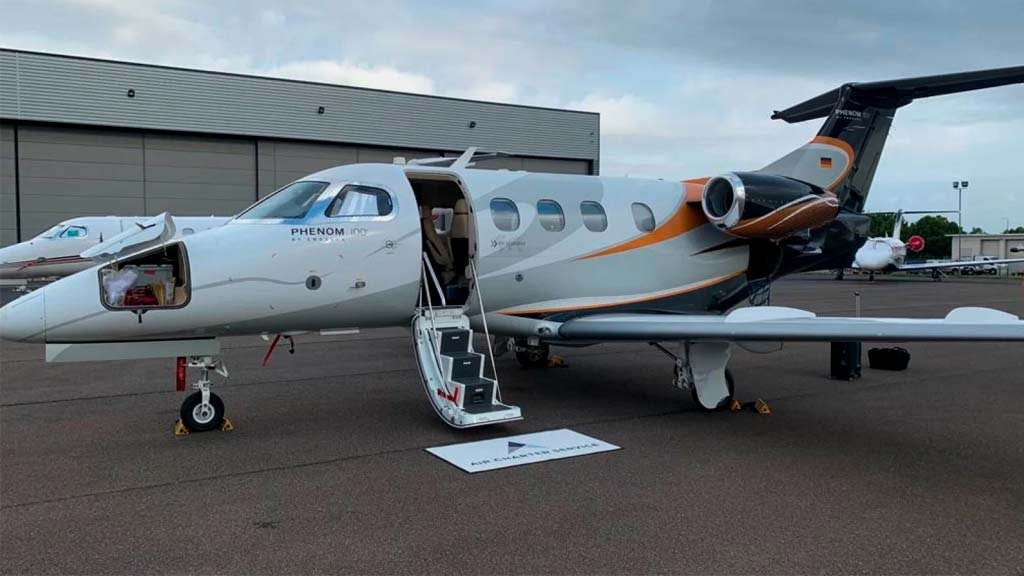 Jato · Very LightEmbraer Phenom 100Specifications, cabin, performance and charter options.Read more
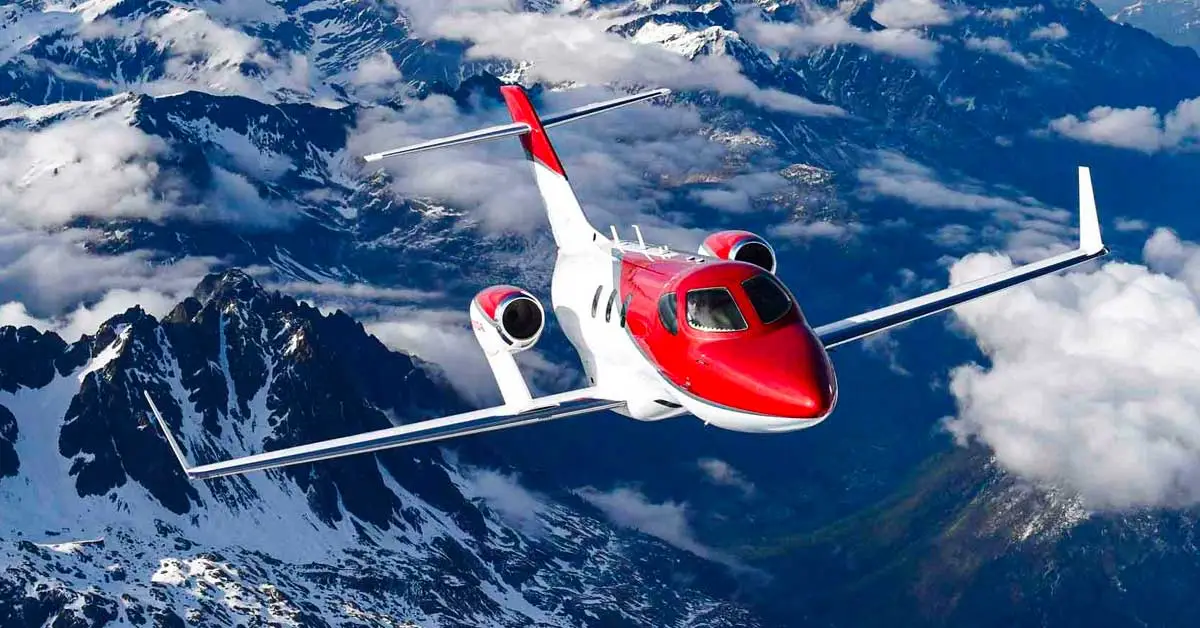 Jato · Very LightHondaJetSpecifications, cabin, performance and charter options.Read more
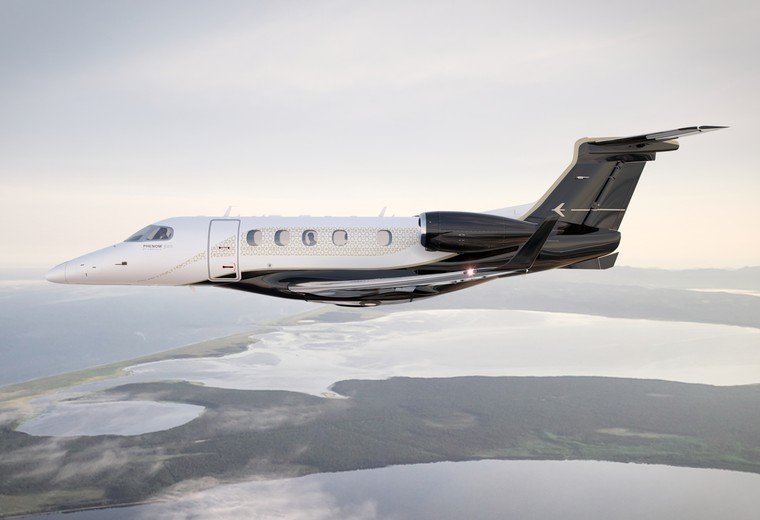 Jato · LightEmbraer Phenom 300ESpecifications, cabin, performance and charter options.Read more
 Jato · LightCessna Citation CJ3Specifications, cabin, performance and charter options.Read more
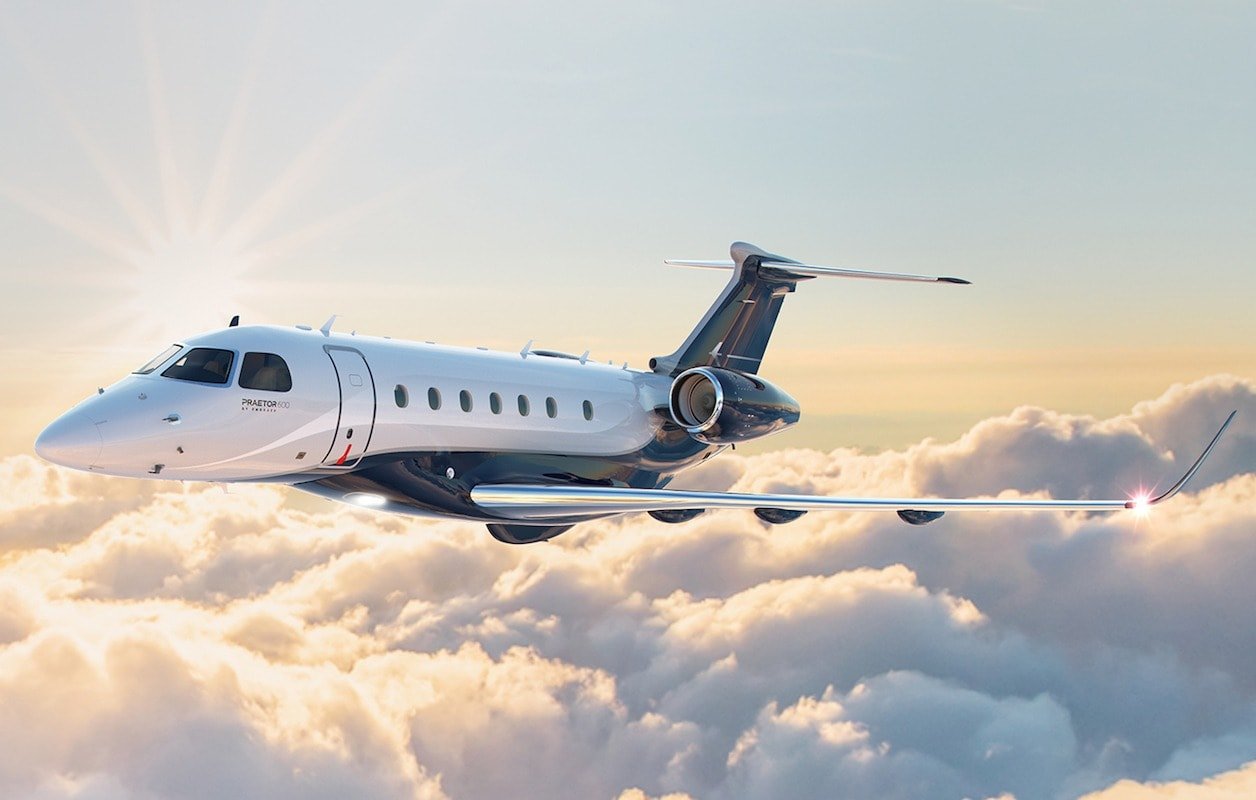 Jato · MidsizeEmbraer Praetor 500Specifications, cabin, performance and charter options.Read more
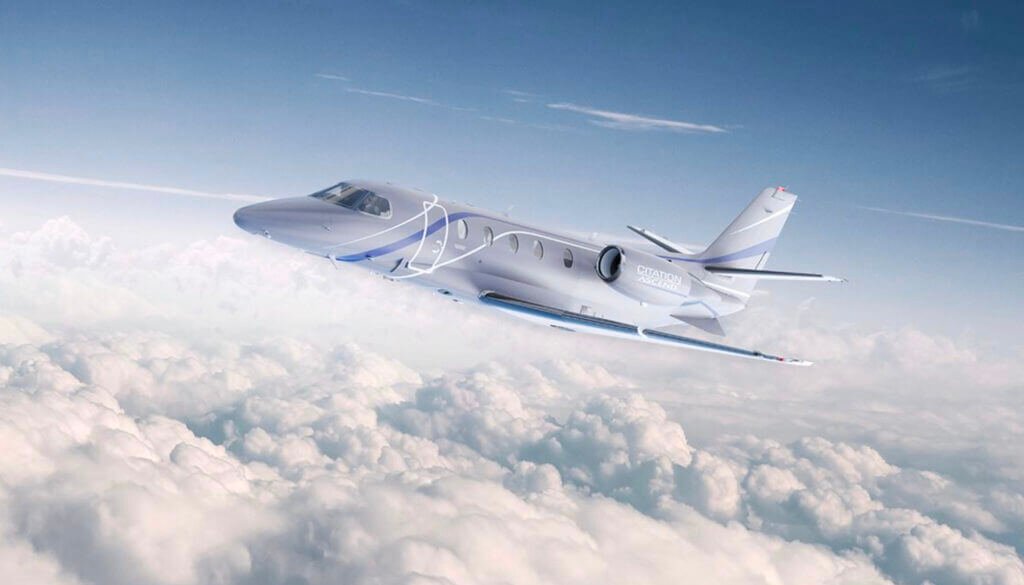 Jato · MidsizeCessna Citation AscendSpecifications, cabin, performance and charter options.Read more
Super-midsize and large: when the business jet becomes an international tool
Super-midsize and large jets serve passengers who need a stand-up cabin, a full lavatory and the range to leave Brazil without a fuel stop. This is the bracket in which the mission stops being regional and expands to the whole of South America, the Caribbean and, with the right model and favorable conditions, the southern United States.
Super-midsize: Challenger 3500, Citation Longitude, Praetor 600 and Gulfstream G300
The Bombardier Challenger 3500 is the benchmark of the category. According to Bombardier's fact sheet, it carries up to 10 passengers, flies 3,400 nautical miles (6,297 km) at Mach 0.77 with four passengers, typically cruises at Mach 0.80 and takes off in 4,835 feet (1,474 m) at maximum weight. The cabin is 1.83 m tall, 2.19 m wide and 7.68 m long, with Ka-band internet and 4G ATG available.
The Cessna Citation Longitude carries up to 12 occupants, flies 3,500 nautical miles (6,482 km), cruises at up to 483 ktas (895 km/h) and takes off in 4,810 feet (1,466 m), according to Textron Aviation. Its cabin is also 1.83 m tall.
The Embraer Praetor 600 is the longest-range super-midsize in the table: 4,018 nautical miles (7,441 km) at long-range cruise with four passengers and 3,719 nautical miles at Mach 0.80. At certification, Embraer cited São Paulo–Miami, London–New York and Dubai–London as examples of nonstop flights. Cabin altitude is 5,800 feet and the eight reclining seats convert into four beds.
In September 2025, Gulfstream announced the G300, which will replace the G280. With data still preliminary, Gulfstream lists a range of 3,600 nautical miles at Mach 0.80 and high-speed cruise at Mach 0.84.
Large: Challenger 650, Gulfstream G400 and G500, Falcon 2000 and Falcon 6X
The large jet, also called a heavy jet, adds a wider cabin, more baggage space and the range to cross the Atlantic on short routes such as Recife–Lisbon. The Bombardier Challenger 650 is a classic in charter and government fleets. At Gulfstream, the G500 flies 5,300 nautical miles (9,816 km) at Mach 0.85, and the new G400, still with preliminary data, is announced with 4,200 nautical miles (7,778 km). Dassault offers the Falcon 2000 family and the Falcon 6X, which has a very wide cabin. The Brazilian pre-owned and charter market also features the Embraer Legacy 650 and the Gulfstream G450.
What changes in the onboard experience
- Cabin height: from about 1.83 m, passengers can walk upright through the cabin.
- Lavatory: enclosed, with a door, and on many models with a sink and space to change clothes.
- Galley: a kitchen area with an oven, microwave and coffee maker, allowing hot meals.
- Rest: fully reclining seats or divans that convert into beds.
- Baggage: a larger compartment, often accessible in flight.
Common mistakes when choosing
A frequent mistake is chartering a super-midsize based on its brochure range for a route that requires almost all of that range, such as São Paulo–Miami, without accounting for wind, weight and an alternate airport. Another is choosing a large jet for short domestic legs and paying for capacity that will not be used. The rule of thumb is to size the business jet for the longest and heaviest leg of the trip, with margin, and let the operator confirm performance for the flight date.
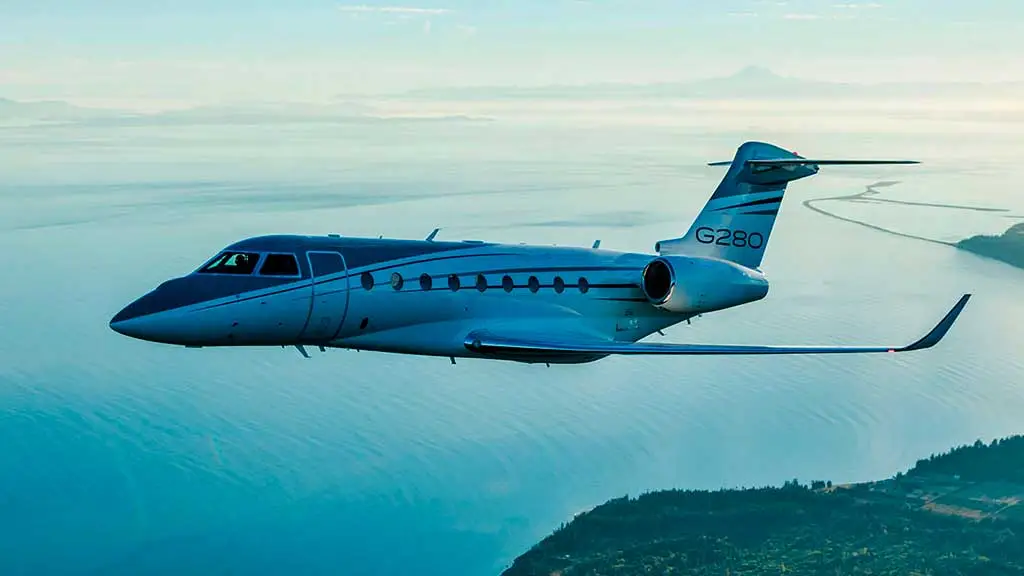
- Super-midsize is the smallest size with a stand-up cabin and international range
- The Praetor 600 was certified citing São Paulo–Miami nonstop as an example
- Large jets add cabin width and baggage space
- Size the jet for the longest and heaviest leg of the trip
Long range, ultra long range and bizliners: private jets that cross oceans
Long range and ultra long range jets exist for one specific mission: linking continents nonstop, with a cabin divided into zones and real rest on board. Departing from Brazil, this is the category that connects São Paulo to Western Europe, the US West Coast and the Middle East.
Long range: Global 5500 and 6500, Gulfstream G600, Falcon 8X
A long range jet flies somewhere between 5,900 and 6,600 nautical miles. The Gulfstream G600, for example, is advertised with 6,600 nautical miles (12,223 km) at Mach 0.85 and high-speed cruise at Mach 0.90. At Bombardier, the family includes the Global 5500 and the Global 6500, and at Dassault, the Falcon 8X trijet. With that endurance, routes such as São Paulo–Lisbon, about 7,935 km in a straight line, and São Paulo–Paris, about 9,400 km, are within nonstop reach in most conditions.
Ultra long range: Global 7500 and 8000, G700 and G800, Falcon 10X
Ultra long range is the top of business aviation. The Bombardier Global 7500 carries up to 19 passengers, flies 7,700 nautical miles (14,260 km) at Mach 0.85 with eight passengers, has a maximum speed of Mach 0.925 and takes off in 5,760 feet (1,756 m). The cabin is 16.59 m long, 2.44 m wide and 1.88 m tall, with up to four living spaces, including a primary suite with a bed, a crew rest area and a kitchen, according to Bombardier.
The Bombardier Global 8000 entered service in December 2025 as the fastest business jet in production: a range of 8,000 nautical miles, a maximum speed of Mach 0.95 and a cabin altitude of 2,691 feet when flying at 41,000 feet, the lowest in current production, according to Bombardier.
At Gulfstream, the G700 flies 7,750 nautical miles (14,353 km) and the Gulfstream G800 reaches 8,200 nautical miles (15,186 km), both at Mach 0.85, with high-speed cruise at Mach 0.90. On June 19, 2026, Dassault flew the Falcon 10X for the first time; it has a projected range of 7,500 nautical miles, a cabin about 2.77 m wide and 2.03 m tall and entry into service planned for late 2027.
Bizliners: commercial aircraft with VIP cabins
A bizliner is a commercial airliner converted for executive use, such as the Airbus ACJ family, which includes the A220-based ACJ TwoTwenty, and Boeing Business Jets, derived from the 737 and from widebody models. A bizliner offers a much larger cabin area, with a bedroom, office, meeting room and, in some projects, a bathroom with a shower, and serves heads of state, large delegations and families traveling with staff. On the other hand, it requires runways and aprons compatible with commercial aircraft and has much higher operating costs. For these missions, Embarque Oficial arranges intercontinental flights with operators approved for the aircraft type and the route.
Speed vs range: the ultra long range dilemma
On ultra long range jets, flying faster reduces range. Gulfstream publishes maximum range at Mach 0.85 and high-speed cruise at Mach 0.90; the speed difference shortens the trip by minutes but burns more fuel per mile. On very long routes, the crew chooses the speed based on the forecast winds, the reserves and the desired arrival time.
Large, long range and ultra long range jets
 Jato · LargeBombardier Challenger 650Specifications, cabin, performance and charter options.Read more
 Jato · LargeEmbraer Legacy 650Specifications, cabin, performance and charter options.Read more
 Jato · Long RangeGulfstream G550Specifications, cabin, performance and charter options.Read more
 Jato · Long RangeBombardier Global 6500Specifications, cabin, performance and charter options.Read more
 Jato · Ultra Long RangeBombardier Global 7500Specifications, cabin, performance and charter options.Read more
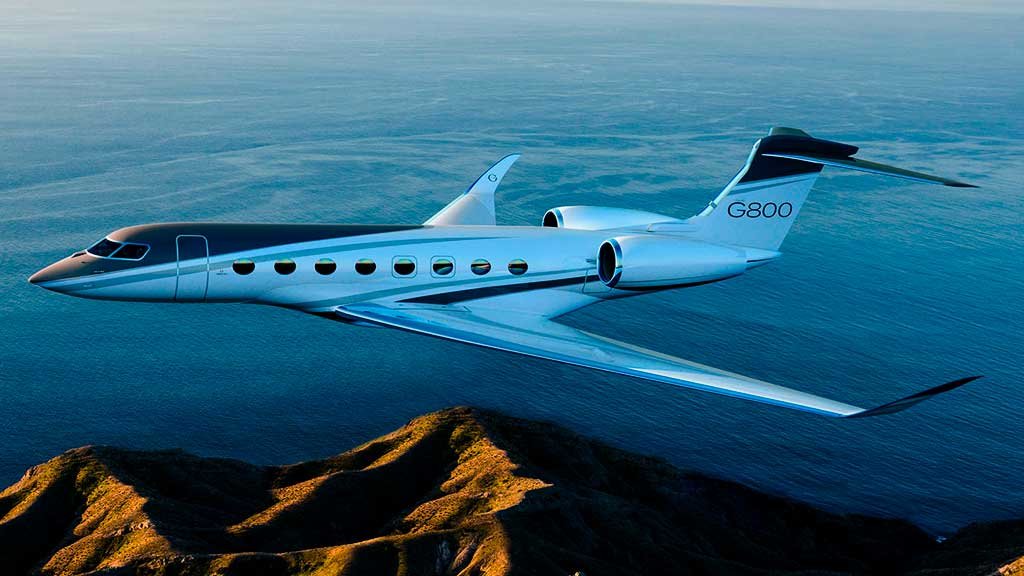 Jato · Ultra Long RangeGulfstream G800Specifications, cabin, performance and charter options.Read more
Jet, turboprop or helicopter: which aircraft makes the most sense?
Not every executive mission calls for a private jet. Turboprops and executive helicopters occupy niches in which they are more efficient, and knowing these boundaries avoids paying for speed that will not be used or choosing an aircraft that cannot land at the destination.
Business jet
A business jet flies higher and faster, usually above layers of bad weather, and is the best choice for medium and long legs, international flights and itineraries in which every hour counts. The limitation is the runway: most private jets need a paved runway with a length compatible with their takeoff weight.
Executive turboprop
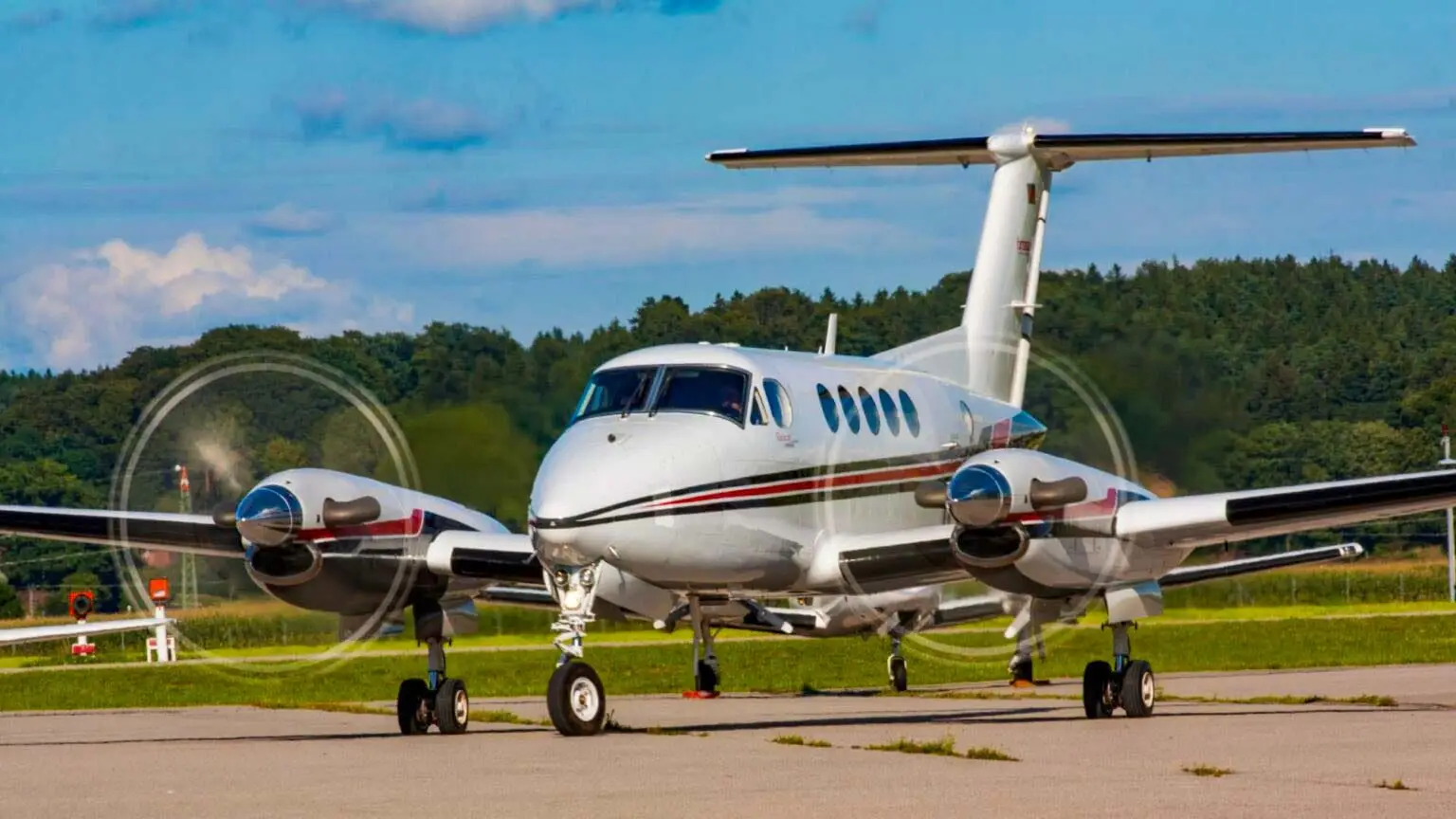
An executive turboprop, such as the Pilatus PC-12 and the Beechcraft King Air family, flies lower and slower than a jet but usually operates from shorter runways and, on some models, from unpaved strips. On short legs, the time difference compared with a jet is small, and the hourly cost tends to be lower. For farms, mining regions, beach destinations with basic airfields and Brazil's interior, the turboprop is often the most rational choice. The King Air B200 is one of the best-known twin-engine aircraft in Brazilian air taxi fleets.
Executive helicopter
An executive helicopter solves the first and the last mile: it links corporate, hotel and residential helipads to airports, avoids São Paulo's traffic and reaches destinations without runways, such as islands and farms. Its range and speed are lower than those of airplanes, and it is more sensitive to weather conditions. A common travel model combines jet and helicopter: the jet flies the long leg and an executive helicopter transfer completes the journey to the final destination. To learn about models, single vs twin engine and helipads, see the Executive Helicopters Guide.
Practical comparison
| Criterion | Business jet | Executive turboprop | Executive helicopter |
|---|---|---|---|
| Speed | The highest | Intermediate | The lowest |
| Cruise altitude | High, above much of the bad weather | Medium | Low |
| Runway | Paved, generally longer | Shorter; some models on dirt or grass | No runway needed: helipad |
| Ideal leg | Medium, long and international | Short and medium, interior | Short, urban and regional |
| Hourly cost | Higher, varies by category | Generally lower than jets | Varies widely by model |
The Pilatus PC-24 case: the jet that lands on dirt
The Pilatus PC-24 holds a unique position because it brings jet performance to runways once reserved for turboprops. According to Pilatus, it cruises at 440 ktas, flies up to 2,000 nautical miles, takes off in 3,090 feet and is certified to operate from short unpaved strips of grass, gravel, dirt or snow, in addition to having a standard cargo door and a cockpit certified for single-pilot operation. For those who need to reach farms and remote regions without giving up jet speed, the PC-24 is an alternative worth considering, always subject to runway approval by the operator.
Rule of thumb
- Leg of less than one hour and a destination without a runway: helicopter.
- Short or medium leg with a short or unpaved runway: turboprop or PC-24.
- Medium or long leg with a paved runway: a jet of the appropriate category.
- International trip: a super-midsize jet or larger.
- Jet: speed and altitude for medium and long legs
- Turboprop: short runways and the interior at a lower cost
- Helicopter: first and last mile, no runway needed
- PC-24: jet performance on approved unpaved runways
What is a business jet cabin like: height, lavatory, galley, bed and Wi-Fi
The cabin is what passengers actually experience during the flight, and it is where private jet categories differ the most. Interior height, lavatory type, galley, the ability to sleep, connectivity and cabin altitude change from one model to another and should weigh on the choice as much as range does.
Cabin height and width
In very light and light jets, the cabin does not allow passengers to stand fully upright, and they move around stooped. From some midsize models onward, cabin height reaches about 1.83 m, which allows walking upright. In large jets, the cabin exceeds 1.88 m and, on the Falcon 10X, reaches about 2.03 m.

| Model | Category | Cabin height | Cabin width |
|---|---|---|---|
| Embraer Praetor 500 | Midsize | 1.83 m | 2.08 m |
| Bombardier Challenger 3500 | Super-midsize | 1.83 m | 2.19 m |
| Cessna Citation Longitude | Super-midsize | 1.83 m | 1.96 m |
| Bombardier Global 7500 | Ultra long range | 1.88 m | 2.44 m |
| Dassault Falcon 10X | Ultra long range | about 2.03 m | about 2.77 m |
Lavatory
In light jets, the lavatory may be a belted seat with a curtain or partition, sometimes optional, as in some Phenom 300E configurations. In midsize and larger jets, the lavatory is enclosed, with a door; long range and ultra long range jets may have more than one bathroom, and bizliners can even have a shower. For trips longer than two hours, confirm with the operator the lavatory type of the specific aircraft.
Galley and onboard service
The galley is the kitchen area of a business jet. On light jets, it is usually an area for chilled items and drinks. On the Praetor 500, Embraer describes a wet galley with a microwave, conventional oven, refrigerator and coffee maker. On ultra long range jets such as the Global 7500, there is a full kitchen and, on many missions, a flight attendant. Catering is booked separately and can be customized.
Bed and rest
Real sleep requires fully reclining seats or divans. On the Praetor 600, eight seats convert into four beds. On the Global 7500, the primary suite with a double bed and the crew rest area allow overnight flights of more than 12 hours.
Wi-Fi and connectivity
Connectivity has evolved quickly. ATG (air-to-ground) systems, which use ground-based antennas, work over land in regions with coverage, such as the United States; Ka-band satellite systems work over oceans and in most of the world. The Praetor 500 offers Ka-band and Gogo AVANCE L5, the Challenger 3500 has Ka-band and 4G ATG available and the Citation Ascend comes with Gogo Avance L3 Max as standard. Before the flight, confirm that the chartered aircraft has Wi-Fi installed, that the plan covers the region being overflown and that the speed is enough for video calls.
Cabin altitude: the detail that reduces fatigue
Cabin altitude is the altitude equivalent to the pressure maintained inside the aircraft. The lower it is, the less the body feels fatigue, dryness and headaches on long flights.
| Model | Cabin altitude stated by the manufacturer |
|---|---|
| Embraer Phenom 300E | 6,600 feet maximum |
| Embraer Praetor 500 and 600 | 5,800 feet |
| Bombardier Global 8000 | 2,691 feet when flying at 41,000 feet |
To compare the cabins of specific models, check each aircraft's technical sheet before requesting a quote, such as the one for the Bombardier Global 6500, listed among the long range jets in this guide.
- Stand-up cabin from about 1.83 m of interior height
- Confirm the lavatory type on long flights
- Ka-band covers oceans; ATG works over land
- Low cabin altitude reduces fatigue on long flights
- A full galley allows hot meals on board
- Real beds appear from super-midsize jets upward
Brochure range vs real range: why doesn't a jet always fly what the catalog says?
The range published by private jet manufacturers is a theoretical figure, calculated under controlled conditions. Bombardier, for example, states in its fact sheets that range is theoretical, with NBAA IFR reserves and a standard atmosphere, and that actual range varies with speed, weather, optional equipment and other factors. Understanding this difference is the simplest way to avoid unexpected fuel stops.
How brochure range is calculated
Each manufacturer describes its assumptions. The Praetor 500's 3,340 nautical miles are calculated with four 200-pound passengers, NBAA IFR reserves with a 200-nautical-mile alternate, winds at 85% annual probability and ISA atmosphere. The Challenger 3500's 3,400 nautical miles are at Mach 0.77 with four passengers and two crew. The Global 7500's 7,700 nautical miles are at Mach 0.85 with eight passengers and four crew. With more people, more baggage or more speed, the number drops.
Five factors that reduce real range
- Wind: a headwind reduces ground speed. An average headwind of 50 knots over 8 hours of flight is equivalent to about 400 fewer nautical miles covered.
- Weight: passengers, baggage and catering take up weight that could otherwise be fuel. On flights at the limit, the operator may restrict baggage or the number of passengers.
- Speed: flying faster burns more fuel. The Praetor 600 flies 4,018 nautical miles at long-range cruise but 3,719 nautical miles at Mach 0.80, according to Embraer.
- Airport temperature and elevation: hot days and high-elevation airports reduce takeoff performance, which may require departing with less weight and therefore less fuel.
- Runway: a short or wet runway, or one with obstacles, limits maximum takeoff weight.
Weight changes the required runway
Embraer publishes a clear example: the Praetor 500 needs 4,222 feet (1,287 m) of runway at maximum takeoff weight, but only 2,842 feet (867 m) for a 1,000-nautical-mile mission. The Praetor 600 takes off in 4,717 feet at maximum weight and in 4,436 feet with four passengers and full tanks. That is why a jet that departs without restriction from a short runway on a domestic leg may need a different airport for a long international route.
Airports that require attention
In Brazil, downtown airports with shorter runways, such as Santos Dumont (SBRJ) in Rio de Janeiro and Congonhas (SBSP) in São Paulo, can limit the takeoff weight of larger jets. In South America, high-elevation airports in the Andes require specific performance calculations. For flights leaving the country, the choice between Guarulhos (SBGR), Viracopos (SBKP) or a business aviation airport may depend on the runway available for the required weight.
How operators turn the brochure into a flight plan
- They calculate the real route, along airways, not the straight-line distance.
- They use the upper-wind forecast for the date and time of the flight.
- They add regulatory reserves and an alternate airport.
- They check runway and temperature at origin and destination.
- They define the weight available for passengers and baggage.
A good rule is not to plan routes that use more than 80% to 85% of brochure range without an analysis by the operator. For legs close to the limit, Embarque Oficial compares alternatives, such as a jet one category up or a well-placed fuel stop, before quoting. See also the technical sheet of the Bombardier Global 5500 for an example of a long range jet with margin for Europe.

- Brochure range is theoretical and uses few passengers
- A headwind can take hundreds of miles off the route
- Weight and heat increase the required runway
- Avoid routes above 80% to 85% of range without analysis
How much do private jets cost? Charter and ownership by category
The cost of flying private jets depends on the category, the route, the season, aircraft repositioning and the access model: one-off charter, hour programs or ownership. The figures below are market estimates with their sources, useful for an initial budget, and do not replace a quote for the actual date and route.
Charter: estimated cost per hour
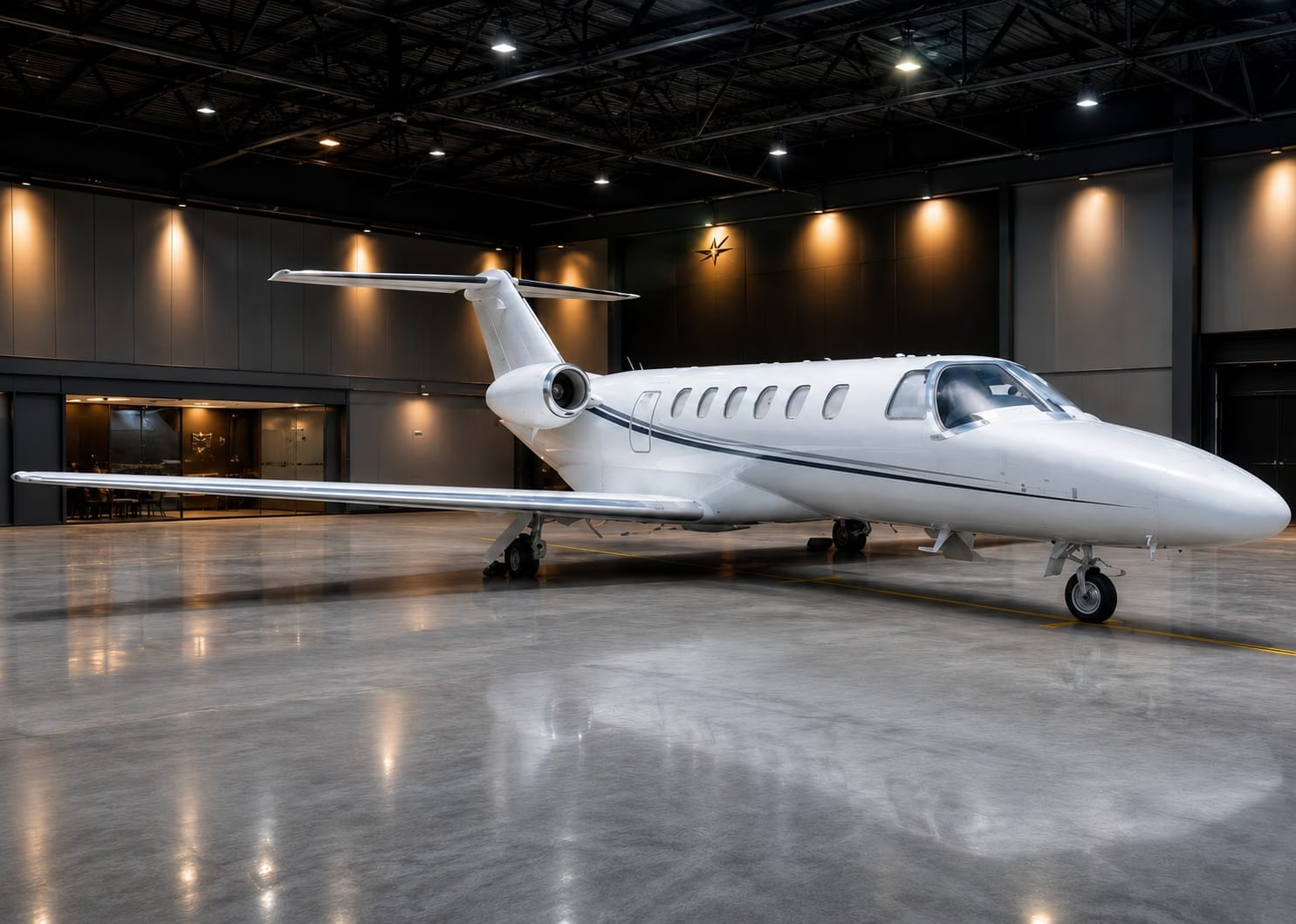
According to Forbes Brasil, in an August 2026 report based on the US market, hourly charter rates fall within these ranges:
| Category | Estimate per flight hour (US, 2026) | What is usually not included in the price |
|---|---|---|
| Light jets (up to 7 passengers) | US$2,500 to US$5,000 | Fees, crew overnight stays, repositioning |
| Midsize | US$4,000 to US$8,000 | Additional fuel, catering, handling |
| Heavy and ultra long range | from US$8,000, possibly exceeding US$15,000 | De-icing, landing fees, special catering |
In Brazil, jet charter is normally quoted per trip, in Brazilian reais (R$), and the final price takes into account moving the aircraft from its base to the origin, the empty return when there are no passengers on the way back, crew overnight stays, airport and navigation fees and taxes. That is why two trips with the same flight time can have very different prices. The exchange rate also matters, because a significant share of jet maintenance and parts costs is priced in US dollars.
How to reduce charter costs
- Choose the smallest category that fulfills the mission: paying for range that will not be used is the most expensive mistake.
- Take advantage of empty legs: empty legs are repositioning flights sold at a discount, with little date flexibility.
- Buy hours in advance: a Jet Card locks in terms for frequent flyers; Forbes Brasil cites minimum purchases of around 25 hours per year in market programs.
- Use a nearby base: aircraft based near the origin reduce repositioning.
Ownership: acquisition price and annual cost
Buying a business jet involves an acquisition price and a fixed annual cost that exists even when the aircraft is on the ground. According to Aviation Week's 2025 Purchase Planning Handbook, list prices for new aircraft were US$12.9 million for the Embraer Phenom 300E, US$20.6 million for the Praetor 500, US$24 million for the Praetor 600 and US$82 million for the Gulfstream G700.
For the cost of keeping a jet in Brazil, Canaltech published these estimates in April 2026 (US dollar figures in parentheses are approximate conversions):
| Item | Estimate in Brazil (2026) |
|---|---|
| Annual maintenance of the Phenom 300 | R$1.5 million to R$2 million, depending on hours flown |
| Cost per flight hour of the Phenom 300 | R$8,000 to R$12,000 |
| Cost per flight hour of the Citation CJ3+ | R$7,000 to R$11,000 |
| Hangar | R$10,000 to R$30,000 per month |
| Crew, including payroll charges | more than R$500,000 per year |
| Aviation insurance | 1% to 3% of the jet's value per year |
| Total annual cost of entry-level models | can exceed R$3 million |
These figures vary with hours flown, aircraft age, engine maintenance program, operating base and exchange rate. Owners can reduce the cost per hour with professional management and by making the aircraft available for charter, the topic of the Aircraft Management Guide. For those who want the benefits of frequent flying without buying an aircraft, the Clube Infinity is another alternative.
- Hourly rates are estimates and change with route and date
- In Brazil, charter is quoted per trip and includes repositioning
- Empty legs cut costs for travelers with flexible dates
- Ownership carries a fixed annual cost even without flying
How do you choose the right jet for each mission?
Choosing a business jet starts with the mission, not the model. The right question is how many people will fly, with how much baggage, between which airports, on what date and with what level of comfort. From there, the category practically defines itself.
Step by step to define the jet
- Count passengers and baggage: include equipment, golf bags, surfboards and pets. Bulky baggage may require a category up.
- Identify the longest leg: the trip is sized by its most demanding leg, not the shortest one.
- Check the runways: airports with short runways or at high elevation may limit takeoff weight.
- Define the minimum comfort: stand-up cabin, enclosed lavatory, Wi-Fi or a bed for overnight flights.
- Consider the season: winds and temperatures change performance throughout the year.
- Ask for the operator's analysis: the performance confirmation for the date is what counts.
Typical routes and suggested category
The distances below are great-circle distances, that is, in a straight line over the Earth's surface, calculated by Embarque Oficial from the airfield coordinates. The actual route flown is longer because of airways.

| Route | Straight-line distance | Suggested minimum category | Note |
|---|---|---|---|
| São Paulo (SBSP) – Rio de Janeiro (SBRJ) | 366 km (197 nm) | Very light or turboprop | Short runway at Santos Dumont |
| São Paulo (SBSP) – Florianópolis (SBFL) | 488 km (264 nm) | Very light | Summer high season |
| São Paulo (SBSP) – Brasília (SBBR) | 872 km (471 nm) | Very light or light | Business and government itineraries |
| São Paulo (SBSP) – Salvador (SBSV) | 1,480 km (799 nm) | Light | Gateway to beach destinations |
| São Paulo (SBSP) – Buenos Aires (SABE) | 1,666 km (899 nm) | Light | Short international flight |
| São Paulo (SBSP) – Recife (SBRF) | 2,129 km (1,150 nm) | Light or midsize | A midsize offers more comfort |
| São Paulo (SBSP) – Santiago (SCEL) | 2,587 km (1,397 nm) | Light or midsize | Crossing the Andes |
| São Paulo (SBSP) – Manaus (SBEG) | 2,704 km (1,460 nm) | Midsize | Heat and humidity in the Amazon |
| São Paulo (SBSP) – Lima (SPJC) | 3,463 km (1,870 nm) | Midsize | Route over the Andes |
| São Paulo (SBGR) – Miami/Opa-locka (KOPF) | 6,583 km (3,555 nm) | Long-range super-midsize or large | At the limit of several super-midsize jets |
| São Paulo (SBGR) – New York/Teterboro (KTEB) | 7,696 km (4,155 nm) | Large or long range | Seasonal wind is decisive |
| São Paulo (SBGR) – Lisbon (LPPT) | 7,935 km (4,285 nm) | Long range | Atlantic crossing |
| São Paulo (SBGR) – Paris/Le Bourget (LFPB) | 9,396 km (5,074 nm) | Long range | Headwind on the return |
| São Paulo (SBGR) – Dubai (OMDB) | 12,217 km (6,597 nm) | Ultra long range | More than 12 hours of flight |
Brazil: domestic flights
Within Brazil, light jets such as the Phenom 300E cover the vast majority of legs between state capitals departing from the Southeast. For the North and Northeast with six or more passengers, a midsize offers more comfort and margin. Destinations with short runways may call for a turboprop or a combination with a helicopter.
South America
Buenos Aires, Punta del Este, Montevideo and Asunción are within reach of light jets from São Paulo. Santiago, Lima and Bogotá require attention to the Andes crossing and to high-elevation airports, which favors midsize and super-midsize jets. Learn more about business flights to South America.
United States and Europe nonstop
For Miami, the Embraer Praetor 600 was presented at certification with São Paulo–Miami nonstop, but in practice wind, weight and the alternate airport decide whether the flight needs a fuel stop. New York, Lisbon, Paris and Geneva call for large and long range jets, and destinations beyond 6,000 nautical miles require ultra long range. Companies with recurring itineraries can structure these flights within a corporate aviation program. To receive a proposal for your route, reach the team through the contact page.
- Count passengers and bulky baggage
- Size the trip by its longest leg
- Check runway length and airport elevation
- Consider wind and the season
- Define the minimum cabin comfort
- Ask the operator to confirm performance
Which business jet manufacturers and models are in production in 2026?
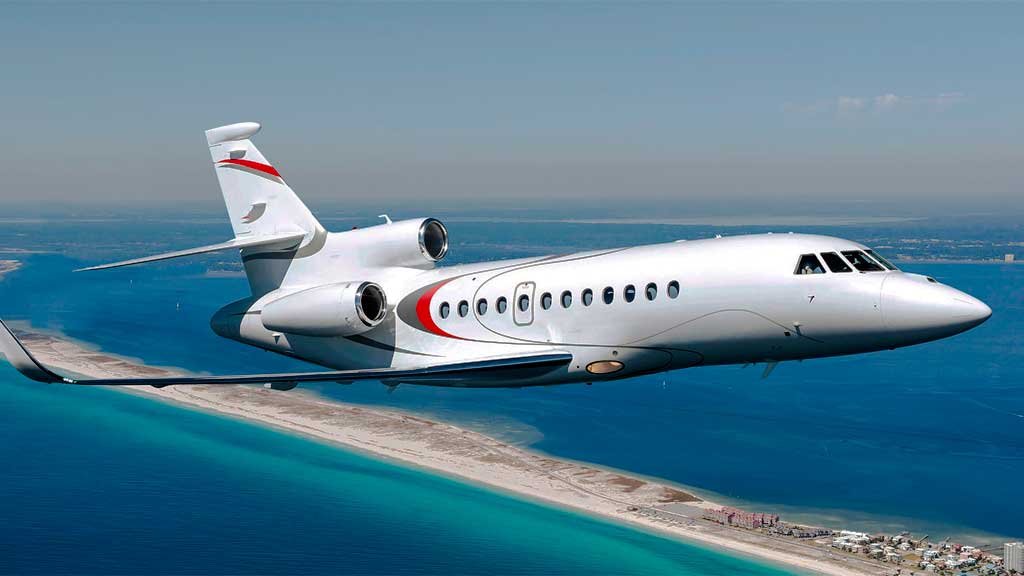
The market for private jets is dominated by a few manufacturers, each with a family of models covering part of the categories. Knowing their portfolios helps explain why certain models appear more often in charter and which launches should reach the market in the coming years.
Embraer (Brazil)
Embraer builds the Phenom 100EV, the Phenom 300E and the Praetor 500 and 600. The Phenom 300E is the world's benchmark light jet. In 2026, Embraer certified with ANAC, the FAA and EASA the Praetor 600E version, on April 30, and the Praetor 500E, on June 30, with larger cabins and payloads and a new cabin management system; the Praetor 600E features a touchscreen Smart Window. According to GlobalAir, deliveries of these versions are not expected before 2029.
Bombardier (Canada)
Bombardier offers the Challenger 3500, the Challenger 650 and the Global family: 5500, 6500, 7500 and 8000. The Global 8000, which entered service in December 2025, reaches Mach 0.95 and has a range of 8,000 nautical miles, with Pür Air purification systems and Soleil circadian lighting.
Gulfstream (United States)
Gulfstream, a General Dynamics company, currently has six models: G300, G400, G500, G600, G700 and G800. The G300 and G400 still have preliminary performance data, according to the manufacturer itself. The G300, unveiled in September 2025, will replace the G280 in the super-midsize segment; the G400 is the brand's new large jet.
Textron Aviation: Cessna Citation (United States)
Textron Aviation builds the Cessna Citation line, from the M2 to the Longitude. The Citation Ascend entered service with its first delivery on December 30, 2025. The new Gen3 generation of the M2, CJ3 and CJ4 light jets, with Garmin Emergency Autoland in the G3000 avionics, was in flight testing in July 2026, when the CJ3 Gen3 made its first flight, still with no published certification date.
Dassault Aviation (France)
Dassault builds the Falcon family, including the Falcon 2000, the Falcon 6X and the Falcon 8X trijet. The Falcon 10X, with a wider cabin than its competitors, flew for the first time on June 19, 2026, in Bordeaux, powered by Rolls-Royce Pearl 10X engines, and is scheduled to enter service in late 2027.
Honda Aircraft Company (Japan and United States)
Honda builds the HondaJet Elite II. Its larger project, the HondaJet Echelon, with up to 11 occupants and a range of 2,625 nautical miles, had its first flight postponed to 2028 and its entry into service to around 2031, according to a September 2026 report; Honda cites more than 530 letters of intent, which are not firm orders.
Pilatus (Switzerland)
Pilatus builds the PC-24, a twin-engine jet certified for single-pilot operation and for unpaved runways, as well as the PC-12 turboprop.
Launches and delivery timelines
| Model | Category | Status in November 2026 |
|---|---|---|
| Bombardier Global 8000 | Ultra long range | In service since December 2025 |
| Cessna Citation Ascend | Midsize | First delivery in December 2025 |
| Embraer Praetor 500E and 600E | Midsize and super-midsize | Certified in 2026; deliveries expected from 2029 |
| Gulfstream G300 and G400 | Super-midsize and large | In development, preliminary data |
| Cessna Citation M2, CJ3 and CJ4 Gen3 | Light | In flight testing |
| Dassault Falcon 10X | Ultra long range | First flight in June 2026; service planned for late 2027 |
| HondaJet Echelon | Light | First flight expected in 2028; service around 2031 |
For those considering a new or pre-owned aircraft, production backlogs weigh as much as price. The Aircraft Acquisition Guide explains valuation, pre-purchase inspection and registration, and Embarque Oficial's aircraft sales and acquisition team helps compare the available options.
- Embraer, Bombardier, Gulfstream, Textron and Dassault lead the market
- Global 8000 and Citation Ascend entered service in December 2025
- Praetor 500E and 600E were certified in 2026
- The Falcon 10X flew in June 2026
Crew and regulations: who can operate a business jet in Brazil?
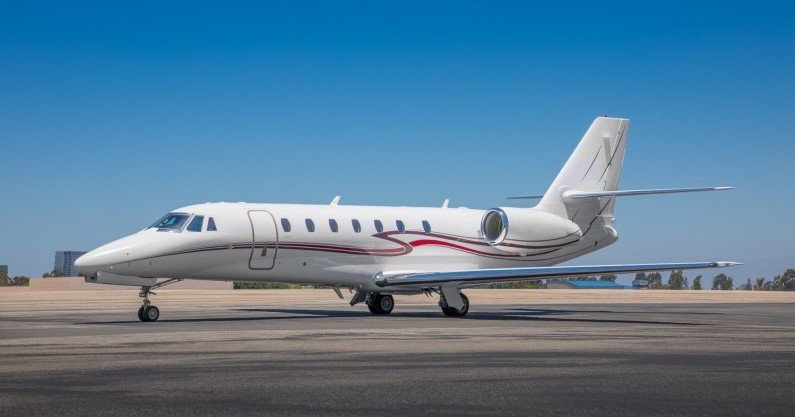
In Brazil, civil aviation is regulated by ANAC (Agência Nacional de Aviação Civil), the national civil aviation authority, and airspace is controlled by DECEA (Departamento de Controle do Espaço Aéreo), Brazil's airspace control department. For a business jet passenger, the most important rule is knowing which regulation the flight operates under, because that defines who is responsible for safety and for the contract.
RBAC 91 and RBAC 135: private flight vs air taxi
- RBAC 91 (RBAC stands for Regulamento Brasileiro da Aviação Civil, the Brazilian Civil Aviation Regulations): sets out the general operating rules and applies to private flights, in which the owner or operator uses the aircraft for their own transport, without selling the flight.
- RBAC 135: sets out the operating requirements for non-scheduled public air transport operations, such as air taxi. The company needs a certificate and operations specifications issued by ANAC.
In practice, this means that only a certified air taxi company can sell a business jet flight to third parties in Brazil. Privately used aircraft, operated under RBAC 91, cannot be rented out with crew to carry passengers for payment. This practice, known in Brazil as táxi aéreo clandestino (illegal air taxi), exposes passengers to insurance, maintenance and liability risks.
Crew: how many pilots fly a business jet
Some light jets are certified for single-pilot operation, such as the Embraer Phenom 300E, the Pilatus PC-24 and the Cessna Citation CJ3 and CJ4; the HondaJet can be flown by one or two pilots. Aircraft certification, however, is not the only rule: the operating regulation, the company's specifications, insurance and the type of flight may require two pilots. In air taxi, passenger operations under instrument flight rules are usually flown with a captain and a first officer. Larger jets are certified for two pilots, and ultra long range flights may carry a relief crew and a flight attendant.
Licensing, duty time and rest
Private jet pilots need an appropriate license, a type rating for the model and recurrent training in a simulator or in the aircraft. Duty time and rest periods for aircrew in Brazil follow Lei 13.475/2017 (Brazil's Aircrew Law) and ANAC regulations. This affects planning: trips with many hours or a same-day return may require an additional crew or an overnight stay, which is factored into the quote.
How to verify that the operator is legitimate
- Ask for the name of the air taxi company and the number of the certificate issued by ANAC.
- Check the registration in the RAB (Registro Aeronáutico Brasileiro, the Brazilian Aeronautical Registry) and whether the aircraft is linked to an operator authorized to provide 135 service, that is, air taxi.
- Ask for the insurance policy with passenger coverage.
- Confirm the assigned crew and their ratings.
- Be wary of prices far below market and of payments to individuals.
Embarque Oficial arranges flights exclusively with ANAC-certified air taxi operators and carries out this check before each booking. The Executive Air Taxi Guide details the charter process. For owners, aircraft management takes care of crew, maintenance and regulatory compliance.
- A flight sold to third parties requires an RBAC 135 certified company
- In the RAB, the aircraft must be authorized for 135 service
- Single-pilot certification does not override the operator's rules
- Crew duty time follows Lei 13.475/2017
- Ask for the certificate, registration, insurance and crew
- Illegal air taxi exposes passengers to risks
Sustainability and technology: SAF, Autoland and the new cabins
Business aviation is going through two transformations at once: pressure for lower carbon emissions and the arrival of safety and comfort technologies that once existed only on commercial aircraft. Both change what a passenger on private jets should ask when booking a flight.
SAF: sustainable aviation fuel
SAF (Sustainable Aviation Fuel) is an aviation fuel produced from renewable or waste sources, such as vegetable oils, fats and residues, which can be blended with jet fuel and used in current engines within approved blending limits. The gain lies in the life cycle: the carbon emitted during combustion is partly offset by the carbon absorbed during the production of the feedstock.
What Brazilian law says
In Brazil, Lei 14.993/2024, known as the Lei do Combustível do Futuro (Fuel of the Future Law), created the ProBioQAV program and set an emissions reduction target for air operators that starts at 1% from January 1, 2027 and reaches 10% from January 1, 2037. Decreto 13.094 (Decree 13,094) of August 12, 2026 regulated the program, and ANAC opened a public consultation on the monitoring, reporting and verification of emissions. According to an analysis by the law firm Mayer Brown, the draft resolution under consultation provides that the obligation applies to operators certified under RBAC 119 or operating under RBAC 129 that emit 10,000 tonnes of CO2 or more per year on domestic flights, and that compliance takes place through the retirement of SAF certificates.
For most air taxi operators flying private jets, this emissions threshold tends to be high, but corporate demand for carbon reports and SAF flights is already part of booking conversations.
Safety technologies
- Emergency Autoland: a Garmin system that lands the aircraft automatically if the pilot becomes incapacitated. It is featured on the new Citation Gen3 generation under development.
- Autothrottle: automatic power control, already standard on the Citation Ascend.
- Integrated avionics: Garmin G3000 and G5000 flight decks and similar systems reduce pilot workload.
- Synthetic vision: depictions of the terrain on the displays that help in low-visibility approaches.
Comfort and efficiency technologies
The newest cabins invest in air and light. The Global 8000 has a cabin altitude of 2,691 feet when flying at 41,000 feet, Pür Air purification and Soleil circadian lighting, designed to reduce the effects of jet lag. Ka-band satellite connectivity enables video calls over the ocean. On efficiency, Honda states that the future HondaJet Echelon will have about 20% better fuel efficiency than other light jets.
What to ask when booking
- Can the operator fuel with SAF or purchase SAF certificates for the flight?
- Does the aircraft have Wi-Fi with coverage for the route?
- How old are the aircraft and its avionics?
- Does the operator provide an emissions report for the trip?
Embarque Oficial helps compare these features across the aircraft available at the time of the quote.

- SAF reduces life-cycle emissions
- Lei 14.993/2024 sets a 1% target in 2027 and 10% in 2037
- Emergency Autoland arrives with the Citation Gen3 generation
- Low cabin altitude and filtered air reduce fatigue
Glossary: key private jets terms
- Business jet
- A jet aircraft designed for on-demand business or leisure transport, with a cabin for a small number of passengers. Also called a private jet or executive jet.
- Very light jet
- The smallest business jet category, with four to six passengers and a range of about 2,000 to 2,900 km. Examples: Phenom 100EV and HondaJet.
- Super-midsize
- A jet category with a stand-up cabin and a range of about 6,300 to 7,400 km, such as the Challenger 3500, Citation Longitude and Praetor 600.
- Ultra long range
- A category of jets that fly more than 7,500 nautical miles nonstop, such as the Global 7500, Global 8000, G700, G800 and Falcon 10X.
- Bizliner
- A commercial airliner, such as Airbus ACJ models and Boeing Business Jets, converted for executive use with a VIP cabin.
- Nautical mile (nm)
- A unit of distance used in aviation, equal to 1.852 km. The range of jets is published in nautical miles.
- ktas
- Knots true airspeed: the true speed in knots relative to the air. One knot equals 1.852 km/h.
- Mach number
- Speed expressed as a fraction of the speed of sound. Large business jets cruise between Mach 0.85 and 0.90.
- NBAA IFR reserves
- The fuel reserve criterion manufacturers use to publish range, which includes fuel for an alternate airport and holding.
- ISA
- International Standard Atmosphere, the reference temperature and pressure condition used in performance data. Hotter days degrade performance.
- MTOW
- Maximum takeoff weight. Published runway distance usually assumes this weight at sea level.
- Cabin altitude
- The altitude equivalent to the pressure maintained inside the pressurized cabin. The lower it is, the less fatigue passengers feel.
- Galley
- The kitchen area of a business jet, with refrigeration, oven, microwave and coffee maker for onboard service.
- Empty leg
- A repositioning leg flown by an aircraft without passengers, sold at a discount and with little date flexibility.
- RBAC 135
- The ANAC regulation (Regulamento Brasileiro da Aviação Civil) setting the operating requirements for non-scheduled public air transport in Brazil, such as air taxi.
- SAF
- Sustainable Aviation Fuel, an aviation fuel from renewable or waste sources that reduces life-cycle emissions.
Frequently asked questions about private jets
What is the difference between a private jet and a business jet?
A private jet and a business jet are, in practice, the same type of aircraft: a jet airplane for exclusive, on-demand transport of a small number of passengers. The term business jet is used more by manufacturers and by the business aviation market; private jet is more common in everyday language, and in Brazil people also say jatinho. What changes the legal status of private jets is who operates the flight: the owner, on a private flight, or an air taxi company certified by ANAC, Brazil's civil aviation authority.
How many passengers fit in a business jet?
A business jet carries from four to more than fifteen passengers, depending on the category. Very light jets carry four to six people; light jets such as the Phenom 300E, six to ten; super-midsize jets such as the Challenger 3500, up to ten; and ultra long range jets such as the Global 7500, up to 19. For comfort on long flights, plan for fewer passengers than maximum capacity, especially if there are beds or bulky baggage.
Which business jet has the longest range?
Among jets built as business jets, the Gulfstream G800 has the longest published range: 8,200 nautical miles, about 15,186 km, at Mach 0.85 with NBAA IFR reserves. Next come the Bombardier Global 8000, with 8,000 nautical miles, the Gulfstream G700, with 7,750, and the Global 7500, with 7,700. Bizliners derived from large commercial airliners can fly even farther.
What is the fastest business jet in production?
The Bombardier Global 8000, which entered service in December 2025, is presented by Bombardier as the fastest business jet in production, with a maximum speed of Mach 0.95. It also has a range of 8,000 nautical miles and a cabin altitude of 2,691 feet when flying at 41,000 feet. At Gulfstream, the G700 and G800 have a high-speed cruise of Mach 0.90.
Can a light jet fly São Paulo–Miami nonstop?
No. The straight-line distance between Guarulhos and Opa-locka, in Miami, is about 6,583 km, or 3,555 nautical miles, while light jets such as the Phenom 300E have a brochure range of about 2,010 nautical miles. For this route nonstop, the minimum is a long-range super-midsize such as the Praetor 600, or a large jet, always with a wind and weight analysis by the operator.
Which business jet can fly from São Paulo to Europe nonstop?
For Lisbon, about 7,935 km from Guarulhos, and Paris, about 9,400 km away, the ideal choice is a long range or ultra long range business jet, such as the Global 6500, Gulfstream G600, Falcon 8X, Global 7500 or G700. Large jets with a range close to 5,000 nautical miles can fly some routes at the limit, depending on wind and passengers. The final confirmation comes from the operator for the flight date.
How much does an hour on a chartered private jet cost?
According to Forbes Brasil, in August 2026, in the US market, light jets cost about US$2,500 to US$5,000 per hour; midsize jets, US$4,000 to US$8,000; and heavy and ultra long range private jets, from US$8,000, possibly exceeding US$15,000. In Brazil, charter of private jets is quoted per trip and includes repositioning, fees and overnight stays, so a quote for the specific route is essential.
How much does a new business jet cost?
According to Aviation Week's 2025 Purchase Planning Handbook, the Embraer Phenom 300E had a list price of US$12.9 million, the Praetor 500 US$20.6 million, the Praetor 600 US$24 million and the Gulfstream G700 US$82 million. Inspection, registration, insurance, hangar, crew and maintenance are added to that amount. Pre-owned business jets cost less but require a careful pre-purchase inspection.
How much does it cost to keep a business jet in Brazil?
According to estimates published by Canaltech in April 2026, annual maintenance of a Phenom 300 in Brazil runs between R$1.5 million and R$2 million, hangar costs between R$10,000 and R$30,000 per month and the crew more than R$500,000 per year. The total cost of entry-level models can exceed R$3 million per year. Professional management and chartering out the aircraft help offset that cost.
Do business jets have a bathroom?
Most business jets have a lavatory, but the type varies. In very light and light jets, it may be a belted seat with a partition, sometimes optional. From midsize jets upward, the lavatory is usually enclosed with a door, and long range and ultra long range jets may have more than one bathroom. On flights longer than two hours, confirm with the operator the lavatory type of the aircraft.
Can you sleep on a business jet?
Yes, from super-midsize business jets upward. On the Embraer Praetor 600, eight reclining seats convert into four beds. Ultra long range jets such as the Bombardier Global 7500 can have a primary suite with a double bed and a crew rest area. In light jets, the seats recline but do not form flat beds. For overnight flights, choose the category based on the possibility of real rest.
Do private jets have Wi-Fi?
Many private jets have Wi-Fi, but it depends on the aircraft and on the system installed. ATG systems work over land in regions with coverage, and Ka-band satellite systems work over oceans. The Citation Ascend has Gogo Avance L3 Max as standard, and the Praetor 500 offers Ka-band. Before the flight, confirm that the Wi-Fi on the private jet is active and covers the route.
What is cabin altitude and why does it matter?
Cabin altitude is the altitude equivalent to the pressure maintained inside the aircraft during the flight. The lower it is, the less the passenger feels fatigue, dryness and headaches. The Phenom 300E has a maximum cabin altitude of 6,600 feet, the Praetor 500 and 600 have 5,800 feet and the Global 8000 maintains 2,691 feet when flying at 41,000 feet, which makes a difference on long flights.
Jet or turboprop: which should I choose for Brazil's interior?
For Brazil's interior, a turboprop is usually more rational when the runway is short or unpaved and the leg is short or medium, because it operates from simpler airfields and has a lower hourly cost. A jet is better for long legs with a paved runway. The Pilatus PC-24 is an exception: it is a jet certified for approved unpaved runways.
Can a business jet land on a dirt runway?
Most business jets operate only from paved runways. The Pilatus PC-24 is an exception: according to Pilatus, it is certified for short unpaved runways of grass, gravel, dirt or snow. Even so, each runway must be assessed by the operator for length, strength and conditions. For farms and remote regions, turboprops such as the PC-12 are also options.
How many pilots does a business jet need?
It depends on the aircraft and the type of operation. Some light business jets, such as the Phenom 300E, the PC-24 and the Citation CJ3 and CJ4, are certified for a single pilot. Larger jets require two pilots. In air taxi operations in Brazil, the rules of the operation and of the company may require a captain and a first officer even on light jets, and very long flights may carry a relief crew.
How can I tell if a private jet operator in Brazil is legitimate?
Ask for the name of the air taxi company and the certificate issued by ANAC, check in the RAB, the Brazilian Aeronautical Registry, whether the registration is linked to an operator authorized to provide 135 service, request the passenger insurance policy and confirm the assigned crew. Be wary of prices far below market and of payments to individuals. Embarque Oficial works only with private jet operators certified by ANAC in Brazil and by the local aviation authority abroad.
What are empty legs on private jets?
Empty legs are legs on which a business jet must fly empty to pick up or return passengers, for example on the return of a one-way charter. These legs are offered at a discount compared with conventional charter, but their date, time and route are not very flexible. They are a good option for travelers who can adapt to the available itinerary. See the offers on empty legs.
Can private jets use SAF?
Yes. SAF, sustainable aviation fuel, can be blended with jet fuel and used by private jets in current engines within approved blending limits. In Brazil, Lei 14.993/2024 created ProBioQAV, with an emissions reduction target of 1% in 2027 rising to 10% in 2037; under the ANAC draft in public consultation, the obligation applies to air operators emitting more than 10,000 tonnes of CO2 per year on domestic flights.
What are the latest business jet launches?
Highlights from 2025 and 2026 include the Bombardier Global 8000, in service since December 2025; the Cessna Citation Ascend, first delivered the same month; the Embraer Praetor 500E and 600E, certified in 2026; the Gulfstream G300 and G400, in development; the Dassault Falcon 10X, which flew in June 2026; and the Citation Gen3 generation, in flight testing.
Sources and references
- Embraer – Brochura Phenom 300E (2025)
- Embraer – Brochura Praetor 500
- Embraer – Praetor 600 recebe certificação brasileira (comunicado)
- GlobalAir – Praetor 500E e 600E certificados, primeira entrega em 2029
- Bombardier – Ficha técnica Challenger 3500
- Bombardier – Ficha técnica Global 7500
- Bombardier – Global 8000 entra em serviço (AviationPros)
- Gulfstream – Linha de aeronaves
- Cessna – Citation Longitude
- AvWeb – Citation Ascend entra em serviço
- Textron Aviation – Primeiro voo do Citation CJ3 Gen3
- GlobalAir – Primeiro voo do Dassault Falcon 10X
- Pilatus – PC-24
- Aviation Week – Aircraft Overview: HondaJet
- AirDataNews – HondaJet Echelon adiado para 2031
- Portal In – Brasil ultrapassa 11 mil aeronaves executivas (dados ANAC/ABAG)
- Forbes Brasil – Quanto custa viajar de jato particular (2026)
- Canaltech – Quanto custa ter e manter um jato executivo no Brasil (2026)
- Aviation Week – Purchase Planning Handbook 2025
- Mayer Brown – SAF: ANAC abre consulta após decreto regulamentador (2026)
Guide written by Régis Hahns, CEO of Embarque Oficial, with the company's editorial team, based on the sources above. Rules, prices and lead times change: always confirm with ANAC, the manufacturer or a specialist before deciding. Embarque Oficial serves clients worldwide, from Monaco, Dubai, Capri and Rome to every region of Brazil, and arranges each flight with operators certified by ANAC, Brazil's civil aviation authority, in Brazil and by the local aviation authority abroad.
Keep exploring the Knowledge Hub
Complete guideExecutive Air Taxi GuideHow charter works in Brazil, what it costs, ANAC rules and how to book safely.Read more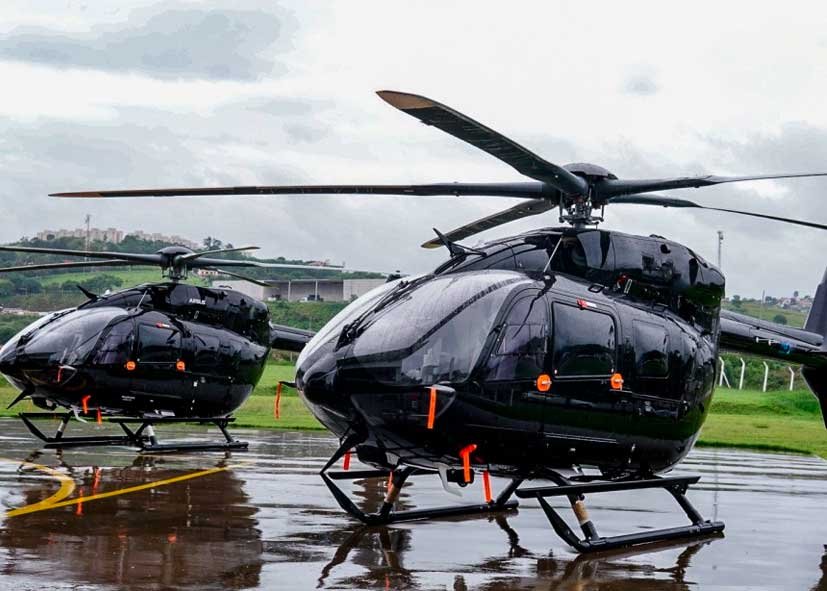 Complete guideExecutive Helicopters GuideModels, single vs. twin engine, helipads and urban mobility by helicopter.Read moreComplete guideAircraft Acquisition GuideEvaluation, pre-purchase inspection, contracts, ANAC registration and pitfalls.Read moreComplete guideAircraft Management GuideCosts, maintenance, crew, compliance and how to lower the cost per flight hour.Read moreComplete guideBusiness Aviation GuideThe sector in Brazil and worldwide: market, rules, technology and trends.Read moreEmbarque Oficial servicePrivate jet charterQuotes for private jets from very light to ultra long range with ANAC-certified operators.Read more
Ready to fly
Tell us where, we take care of the rest
Confidential quotes and 24/7 support, every day of the year.
WhatsApp +55 48 98877-0541 · sales@embarqueoficial.com